

The Welcome at Besk.

Updated: Aug 5
A Friday night at Besk and How Hospitality Is the Central Craft of the Next Age.
-----
The Watering Hole
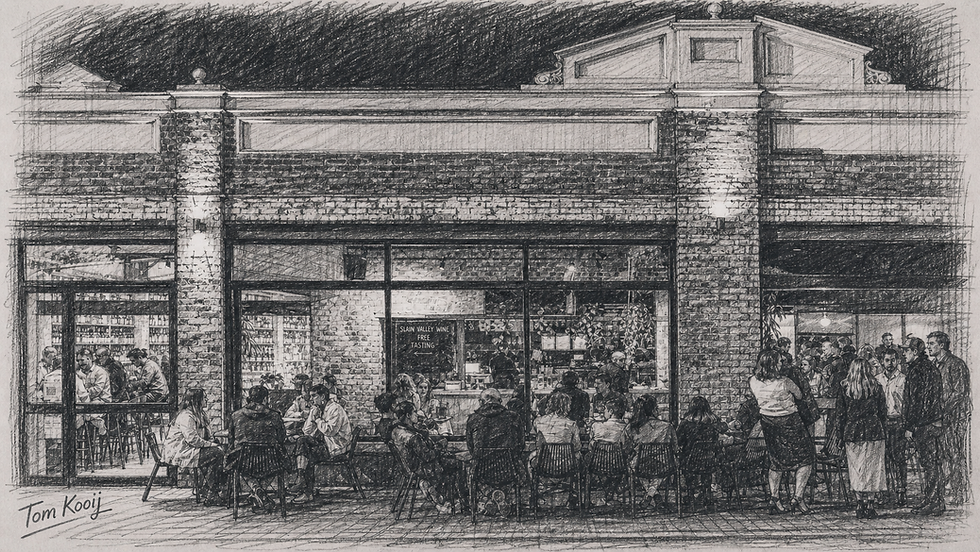
Besk on a Friday night is like a watering hole in the savannah.
Five-thirty, the sun set makes its way through the front windows, Railway Parade outside lined with cars arriving to drop off and circle back. A Ferrari pulls past. Two Mercedes-AMG G 63s pull into the front parking bays with a slow arrogance of a vehicle aware of being looked at. One black Range Rover Sports squeezes in behind them, a white Maybach arrives at six-forty parking in the bus bay across the road, the way only a Maybach does, the matte-grey Aston Martin tucked into the laneway because the owner, one of Perth's top corporate advisors, does not want it parked out in the open. The tables outside are already overflowing and crowds are attempting to squeeze in through the glass main entrance, the way you see a herd gathering at dusk.
Inside, the species sort themselves.
The gazelles come in first. Long legs, mid-twenties to mid-thirties, dresses chosen with care, LBDs, maxi and mini dresses or whatever the tik-tok algorithm tells them is the top cocktail dress trend of 2026. They arrive in groups of three or four. They are not nervous. They have evolved for this exact environment over hundreds of Friday nights, and they move through it like they own the lease. They know which corner of the bar gets the best light and which window catches the sunset behind them. They are aware of every other animal in the room within sixty seconds and have already made fifty quiet decisions about who is worth eye contact and who is not. None of this is hostile. It is the metabolism of the species in its native habitat. A few of them will go home with someone tonight. Most of them will not, because most of them did not come for that. What a fair number of them actually came for, if you press them honestly, somewhere between the second and third drink, is the older version of this....the version their mothers had.
The young lions come in next. Late twenties, early thirties, Zegna suits or the looser Italian equivalent, shirt collars open, watches, Rolex Oyster Perpetual, a faint cloud of Tom Ford or Giorgio Armani coming off them. They puff their chests because they have learned, mostly correctly, what works in this room at this hour. They order the first round at the bar standing up rather than sitting because standing reads taller (and there are no tables available). They check their reflections in the bar mirror without quite admitting to themselves they are doing it. One in every group of five is genuine, the one who has been doing this every Friday since university. The others follow his lead without knowing they are. They are running on testosterone or issues from their childhood none of them will name out loud. Maybe they are looking for sex or a wife, but I think really they are looking to be seen as men who belong in the room, which is a different hunger entirely, and one no woman in the place can actually feed...
The wiser lions come in around seven. Forty-something, jeans and a shirt and a navy sports jacket cut at Parker & Co. They drive a Mercedes and occasionally the older 911 they bought before the prices went mad. They run businesses, sit on boards and have done enough Friday nights at bars in enough cities to know the only thing that works is presence. They walk into the room without scanning it. They greet the manager and the regular bouncer on the door by name. They order a drink at the bar and are mildly amused by the young lions, the way an older man is amused by a younger version of himself who is about to mess-up an evening for entirely predictable reasons. They know some of the gazelles are watching them and some are not, and either is fine.
The lionesses come in around the same time. They are not on the prowl in the way the cliché would have it. They are commanding. They arrive in prides of three or four and they take a corner of the room and make it theirs by sitting down. Saint Laurent backless black dresses or the like. Cut and curated perfectly for their body. Shoes costing what the young lions' first car cost. Hair done, but not in a way looking done. Skin of women who have figured out sleep, water, and the Blanc skin-clinic in Cottesloe are necessities. They are the women running things in this city. The lawyer with her own practice. The founder whose business has just done a raise nobody is talking about yet. The interior designer whose renovations show up in Vogue Living. The PR director who knows everyone in the room. A wiser lion who spotted them enter, is a friend and kindly delivers them a bottle of Louis Roederer '244 Collection' to their table, so they don't have to get up. They are laughing in the register women use when entirely at ease in their own company.
The operator couples come in together. He runs the businesses. She runs the businesses too. They drink early and leave early because they have a son and a daughter at home and a flight to Sydney on Monday morning. They are warm without being soft.
The hyenas come at the edges. The five-man table near the window. Lawyers, maybe. Almost certainly bankers or property managers. The modern Perth version of confidence with a handle on the bar and a divorce around the corner none of them are currently thinking about. The drinks come in rounds. The conversation is loud enough to carry, which is the entire point of the volume. They are not really talking to each other but are talking at each other in the direction of the next table over, hoping the sound will land. None of them will ask the women a single question worth answering. By eleven they will be legless and one of them will be embarrassing himself on his way to a kebab he will not remember tomorrow.
The next table over is three elephants, mid-thirties.
And before you reach for the obvious, no. They are not heavy. Two of them are in the kind of shape requiring serious gym hours and the third has the natural metabolism of a woman whose mother was probably a model. They are called elephants because elephants are what they actually are.
Female elephants run in tight matriarchal herds. When one of them is in distress, the others encircle her. Touch her. Stand with her. Naturalists have documented elephants holding vigil over a wounded or grieving member for hours, sometimes days, refusing to leave until the herd can move as one again. They have memories spanning decades. They recognise the bones of their dead. They are among the very few animals on the planet shown, in hard scientific literature, to grieve.
That is what is happening at this table.
One of them is going through a tough stage in her relationship at home. The other two are taking turns holding her through it without making it the only thing on the table. Their conversation is the kind women have when they have known each other long enough to be silent without it being awkward. They have heard every word from the lawyers' table. They are aware of the noise the way an elephant is aware of hyenas at the edge of the clearing, but without the slightest suggestion the noise registers as threat. Hyenas do not bring down elephants. Elephants simply continue.
Then there are the watchers.
A man two-high tables down from the gazelles does not fit any of those categories, and that is precisely the point of him. Forty-something. Pale blue shirt out over jeans, sleeves rolled to mid-forearm, the watch you only notice if you know your watches. He has been here for about half an hour. He bought a carafe of Chardonnay from the Macedon Ranges. He is not waiting for anyone. He is not on his phone, which alone makes him notable in this room. But is just, slowly, drinking his wine and watching the world turn...
The bartender has spoken to him three times. Each time around ten or eleven seconds. Twice about the wine. Once, briefly, about the cricket. Eye contact. A question. A nod. That has been the entirety of his social interaction in the last two hours.
In about twenty minutes, he will finish his wine, push out through the crowd at the door, walk to his car, drive home, eat something out of the fridge, watch half an hour of a series he has already seen, and go to bed.
He is not lonely in the visible sense. He has work. He has a circle of friends. He has a family. But on some Friday nights, this is what he does. He comes here to stand at the bar, drinks wine, exchange thirty seconds of attention with the person pouring them, and feel his nervous system come down two-levels in a room full of strangers paying him no particular attention at all.
He could not articulate why this works. He just knows it does.
I am there too, Fridays are when I go. Usually a meeting has run long and transitioned, by mutual unspoken agreement, into drinks. Sometimes a deliberate catch-up three weeks in the making. Sometimes a friend, sometimes an acquaintance, sometimes a contact becoming a friend, sometimes the other way around. The city builds itself out of these conversations. Half the work I do, the work actually mattering, gets done in rooms like this rather than in offices. The deal closing. The introduction turning into the partnership. The friendship you realise, fifteen years later, was the most consequential thing the decade gave you. None of these things happen on Microsoft Teams.
This essay (or mini-book...for it's length) is what I have been working out, across those Fridays, over the last few months. Why the watering hole works? Why the species sort themselves? Why the man who comes on his own is doing something more important than he can name? And why it is going to matter more, not less, every year from here on...
The Second Renaissance, Lived In
A few months ago I wrote a piece about the second renaissance. My argument compressed to a line is; when something once scarce becomes abundant, civilisations reorganise around whatever is still scarce. The printing press did this with knowledge five hundred years ago. AI is doing it with cognition now. First-draft thinking, drafts of strategy, drafts of writing, drafts of analysis, available on demand at marginal cost...
That essay landed in the abstract. Cities and regions, knowledge and authority, taste and judgement.
The question I have been refining since is sharper. If intelligence is becoming abundant, what is the actual scarcity taking its place? Not in theory. In felt life. In bodies, in rooms, on Friday nights at watering holes.
The answer, when you put the data and the lived experience side by side, is something simple, it is the felt experience of being received as a human being...
It is the eleven seconds at a bar where someone sees you. The unhurried attention. The sense, in a room packed to the brim of well-dressed strangers, of someone glad you are there.
The species at Besk know this in their bodies even though they do not have language for it.
The young lions are not at the bar for the beer or even, if you press them honestly, for the chance with the gazelles. They are there because the bar is where the herd gathers...
Because being in proximity to other warm bodies who matter is what their nervous system was built for. The lionesses are there for the same reason in different costume. The watcher is there for the same reason without the costume at all.
This is hospitality, operating in the wild, in a building most of them have never thought of as anything more than a bar. It is the central operational technology of human continuity in an age when almost nothing else about being human will be irreplaceable.
This is hospitality, operating in the wild, in a building most of them have never thought of as anything more than a bar. It is the central operational technology of human continuity in an age when almost nothing else about being human will be irreplaceable.
Why the City Starves
The cars on Railway Parade are part of the story.
The savannah metaphor is not a metaphor in the lazy sense.
Cities are concentrations of ambition, capital, and beauty in the way the savannah is a concentration of game, water, and predator. The species sort themselves around the watering hole because the watering hole is where the action is, and the action is what brought them to the city in the first place.
This is worth slowing down for, because it explains the density of what is happening at Besk and why the same hunger filling the room is the same hunger leaving it empty on the wrong night.
People come to cities because cities concentrate opportunity. The young lawyer leaves Bunbury for Perth because it is where the firms are. The founder leaves Geraldton for Subiaco because Subi is where the capital is. The interior designer leaves Albany for Mount Lawley because that is where the clients live. Every body in the bar on Friday evening is, in some version, the result of a migration toward concentration. They came for the work, the money, the partner, the proximity, the validation, the crack at something bigger.
What none of them came for, and what most of them do not realise they have signed up for, is the structural loneliness living underneath the concentration.
The data, if you bother looking, is a slow horror show.
The University of Sydney's Ending Loneliness Together report dropped in August 2025 and the headline number was forty percent of young Australians now lonely. One in three of the rest of us at any given time. One in four locked into the persistent kind, the sort that has been there for two years or more and has stopped feeling like a phase. The Household, Income and Labour Dynamics survey (the longitudinal tracking the Sydney report leans on) has been logging the same pattern for two decades. Social contact in this country has been quietly bleeding out since the late nineties. By August 2022, the share of Australians who reported never meeting anyone socially had more than doubled from where it sat before the world shut down. The healthcare bill alone is now running around $2.7 billion a year, which does not count whatever the productivity cost is, or the mental health cost, or what it does to a country to have an entire generation reach thirty without learning how to walk into a room.
The same picture, drawn in different colours, in every comparable country in the OECD.
And the punchline, if you care to look at it, is geographic. The corridors lighting up loneliest on the maps are not the regional towns. They are inner Sydney, inner Melbourne, the apartment belts of Brisbane and Perth. The most populated, most economically dynamic, most ostensibly connected places on the continent are the places quietly producing the highest concentrations of unattached, undermet, technically successful, emotionally vacant adults the country has ever produced.
Researchers have started using a term for what is happening here. Cocooning. The withdrawal into the digital world for everything except what science says people most need, which is socio-emotional support and connection. The cocoon does not look like loneliness from the outside. It looks like productivity. It looks like a one-bedroom apartment in West Perth with a Peloton, a stack of Marie Kondo books, a grocery delivery from Coles, three streaming services, and a calendar full of appointments most of which are virtual. The loneliness is structural. The cocoon dweller is not without friends. The cocoon dweller has not been in a room full of warm bodies, where strangers brushed past and a bartender nodded at them, in three weeks.
Add to this the hunger endemic to the urban professional class. People who came to the city to do something hungry are statistically more likely than the population average to be running on ambition detached, somewhere along the way, from the human reasons it was supposed to serve. The forty-five year old partner at the firm who has not had a Friday off in fourteen months and whose wife has stopped asking. The thirty-three year old founder who has not slept properly since the Series B and who is micro-dosing things he probably should not be. The thirty-eight year old GP with eight thousand patients on her books who has not seen her own friends since Easter and who cried in the car last Tuesday for no reason she could name. They came to the city to win. They have, by most external metrics, won. And yet, they are starving.
This is the population at Besk. Not all of them. But enough of them. The young lions, even the puffing ones, run on a hunger the suit cannot quite hide. The wiser lions know what the hunger feels like and have learned, painfully, the watering hole is one of the few places actually feeding it. The lionesses know all of this, often more clearly than the men, and have decided to do something about it by forming prides holding each other through the weeks the city does not.
The watering hole works for them because the watering hole is what their bodies were built for. Not a poetic claim. Biology.
Medicine the Body Already Knows
Robin Dunbar, the Oxford evolutionary psychologist who has spent forty years on this, would tell you the human nervous system did not evolve for one-bedroom apartments and screens. It evolved for the savannah and the village and, for the last few thousand years, for crowded indoor rooms full of other warm bodies. The endorphin system, the bonding chemistry producing the felt sense of being human-with-other-humans, fires on physical proximity, shared rhythm, laughter at close range, and the small accidental contacts happening when a body is in a crowd.
His 2025 paper in the Annals of the New York Academy of Sciences, titled flatly Why friendship and loneliness affect our health, makes the medical case. The number and quality of close friendships is one of the strongest predictors of physical and mental health we have, more predictive in some studies than anything except quitting smoking. The supporting infrastructure for those friendships, the ambient social environment keeping the nervous system regulated between meetings with the friends themselves, is the kind of room everybody at Besk is currently standing inside.
Watch what happens, physically, when someone comes in alone at seven-fifteen and tries to get to the bar.
The crowd around the bar is now four deep in places. You have to squeeze and brush past four or five strangers to just get to the cocktail making section where they are calling your drinks. A hand at the small of a woman's back, lightly, to indicate you are passing. Eye contact and a nod with the man whose shoulder you are sliding past. A murmured excuse me nobody really can hear. A moment of body contact, intrusive in any other context. Here it is the entire architecture of how the room works.
These micro-contacts are the medicine...
Stephen Porges, with his polyvagal theory, has spent thirty years describing the same biology from the bottom up. Neuroception. The body decides whether you are safe in this room based on micro-signals it processes faster than thought. Eye contact. Vocal tone. The warmth of a greeting. The willingness of a stranger to make space for you at the bar. Whether the bartender looks up when you arrive or whether you are just a ticket in the queue. If neuroception reads safety, the body opens. Heart rate variability stabilises. Breath deepens. If neuroception reads indifference, the body closes. You leave the encounter slightly more depleted than when you walked in, even if nothing visibly went wrong.
Both Dunbar and Porges, in technical language, describe what every good bartender already knows and has known since long before the science caught up. The eleven seconds of attention you give to the man at the bar, on his own, drinking his second beer slowly, is doing something to him no screen, no app, no thousand-dollar therapist can reach. It is, in his nervous system, a piece of medicine. It is also the cheapest medicine on the menu, and the one most cities have collectively forgotten how to dispense.
The 2025 World Happiness Report, published by Oxford's Wellbeing Research Centre, contained a finding which should have stopped national conversations. One in four Americans now eats every meal alone. Solo dining is up 53 percent since 2003. People who regularly share meals with others report life satisfaction increases comparable to the effects of income or employment.
Third Place
There is an older argument in the urban sociology literature explaining why a room like this matters as much as it does, and why its loss is more consequential than anybody fighting over commercial leases tends to admit.
Ray Oldenburg was an American sociologist who spent the 1970s and 1980s watching what was happening to community in middle America as suburbanisation, the highway system, and the privatisation of leisure quietly rearranged how people spent their evenings. He noticed Americans were losing something they had once taken for granted, something with nothing to do with home and nothing to do with work, but holding communities together for as long as there had been communities. He started calling it the third place, and in 1989 he published a book called The Great Good Place giving the rest of us the vocabulary to describe what was disappearing.
The home is the first place. Work is the second. The third place is the room where you go neither, where you are known, where the social contract is light, where you can be received without being interrogated. The cafe. The restaurant. The bar. The pub. The barber shop on the corner of the high street running for forty years. The third place, Oldenburg argued, is what makes modern urban life liveable for human beings who would otherwise be alone in their houses or grinding at their desks. Where strangers become neighbours. Where loose social ties get maintained without effort. Where the city remembers it is a city.
It is also, by every available indicator, in collapse.
UK pubs fell below 39,000 in 2024 for the first time in modern record. Eighty pub closures a month, on average. The U.S. independent restaurant sector contracted 2.3 percent in 2025, a net loss of more than nine thousand five hundred locations. The James Beard Foundation found 42 percent of operators not profitable, sixty percent saying conditions had deteriorated. The 2024 figures show seventeen percent of Americans report having zero close friends, up from two and a half percent in 1990. A sevenfold rise in a single generation.
These are urban statistics. The third places dying are mostly city third places. The loneliness numbers are densest in the cities. The places looking, from the outside, like they should be the most connected environments in the country are quietly producing the highest concentrations of unattached, undermet, technically successful, emotionally vacant adults the country has ever produced.
You want evidence of how starved the city has become for the actual thing? Look at what happened in Manhattan in February 2025.
Two Australian hospitality operators, Eddy Buckingham and Nick Stone, opened a 430-capacity pub in Lower Manhattan called Old Mates. They had a roster of Australian celebrity backers behind them (we're talking Hugh Jackman, Hamish and Andy, Patty Mills, Mick Fanning, Pat Cummins, Ash Barty) but the proposition was not celebrity. The proposition was a working pub. Three floors of dark timber and worn-in corners. Coopers on tap. Parmas on the menu. AFL on the screens. Sunday roast. Trivia on Tuesdays. The deliberate, painstaking recreation of how a corner pub feels in Fitzroy or Richmond, set down on John Street in the Financial District.
The pre-opening party was scheduled to run from four in the afternoon until midnight. They expected, on a generous estimate, a couple of hundred people. Seventy were waiting outside before the doors opened at four. By five-thirty they were at capacity. By nine-thirty they had run out of beer. They had to close the doors. People kept queuing in the cold anyway, hoping for a chance to get in.
It has been like that ever since. Lines around the block on a Friday. Lines around the block on a Tuesday. Lines around the block in the rain. New York's real Aussie embassy, the press has taken to calling it. Stone, one of the operators, said the line naming what is actually happening. The Australian pub is more than a drinking spot. It is a gathering place, a communal hearth. People here are chasing home.
The home they are chasing is not Australia. Most of the lines outside Old Mates are not Australian expats. They are New Yorkers.
They are chasing a kind of room the city forgot how to build, in a country which has spent four decades dismantling the third-place infrastructure holding its towns and neighbourhoods together. They are chasing the warmth intrinsic to a culture which has not yet entirely commercialised its own pubs.
What Old Mates has accidentally proved, on the most expensive few square metres of hospitality real estate on the planet, is the demand for the actual thing, the third place, run with conviction, populated by people who know what hospitality means at the level of the body, now sits so far in excess of supply a 430-pax in Lower Manhattan cannot keep beer in the fridges fast enough.
This is what the data has been pointing at. People will queue. People will pay. People will travel and will rearrange their week around it. Not because they want to drink. Because they want to be in a room.
Besk on a Friday is a smaller, quieter Australian version of the same proposition. Most great rooms in any city in the world are the same proposition again, expressed in whatever local idiom the country has to hand. The restaurant, the bar, the pub. Three forms of the same room, expressed at different price points and different intensities. The fine-dining tasting menu and the corner pub middy are not separate categories. They are the same craft, performed at different volumes, by people who have decided what happens in the room matters more than what shows up on the till.
This is the third space, in all its forms. And on a generation's current trajectory, we are losing it room by room while spending most of our public attention on whether or not the AI agent will write a marginally better email.
The People Who Hold the Room
The rooms still standing are still standing because someone is doing the work.
The bartender has been on his feet since eleven in the morning. He will be on them until past midnight. The chef has been in since six this morning and rejected half the seafood order at twenty past seven, which made the supplier swear at him on the phone, which neither of them are going to mention next week. The owner had been at a corner table with a coffee gone cold, going over an invoice with his business partner and wife. They both have a look on their face anyone who has run this kind of room will recognise. They are not props in someone else's good night. They are the foundation of the room. They are people who have chosen this work, are still learning it after a decade in, and have decided to spend a Friday making sure a roomful of strangers leaves slightly less depleted than they arrived. Most of the room will never know they were here. None of the room will know what it cost them.
The eleven seconds of face time at the bar each person gets is no accident. It is the surface manifestation of a much harder, much rarer and more intentional discipline running all the way down through the staff, through the senior team, through to whoever is running the bar.
Eleven Seconds
Eight-thirty. The room has shifted again.
The first wave is gone. The hardcore crowd has settled in. The volume has dropped a smidge. The bartenders have stopped sprinting. Two of them are now moving in the easier rhythm good bars find for the back half of a Friday, where the conversations get a bit longer, and the orders get a bit more particular.
A lioness walks in alone.
Mid-thirties. a black lace mini-dress, not new but an outfit that has done this night many times. Hair doing what she wanted it to do. The kind of confident she has earned. She has come from somewhere and is going to meet friends running late. She does not know if they are running ten minutes late or thirty. She is not nervous, but as the same time is also not entirely at ease. The room is full of people already somewhere with someone, and walking into a watering hole alone, on a Friday night, is its own particular kind of exposure even when you are not new to it. Two of the lions in the room have already spotted her in the first thirty seconds and are working out their approach. She is aware of this. She is uninterested. She has done this dance enough times to know how it ends, and tonight she did not come for the dance.
She finds a small gap at the bar. She does not push but waits.
The bartender notices her in the first two seconds.
He does not staging anything. He nods at her, asks what she would like in a tone suggesting he has all the time in the world even though he very much does not. She tells him. He pours a glass of Champagne. He places the drink in front of her with both hands, a thing the good ones do without thinking about it. He says something quiet, not transactional but simply welcoming. Friends running late? She nods. Take your time. He moves on.
She exhales, in a way her body has been waiting to exhale since she got out of the Uber.
That was eleven seconds. From an operational standpoint, the interaction has cost the bar nothing. From the bartender's standpoint, he will not remember it tomorrow. From hers, she will remember it for a week. Possibly longer.
Her nervous system has just been regulated by another human being in a way no algorithm in the world is currently capable of matching. She will sit at the bar for forty minutes. Her friends will arrive. The night will be better than it would have been. She will come back to this bar. She will tell other women about this bar.
She will, without ever quite articulating it to herself, have decided this is one of the rooms where she is met.
That is the craft.
The Source Is in the Leader
Those eleven seconds is downstream of whether the operator running the bar has been deeply seen at some point in their own life, and has built the internal capacity to do the same in return. The capacity transmits down the chain. The leader does the work to be sturdy. The senior staff watch what it looks like in hard moments, repeatedly, over years. They begin to do it for the line. The line learns it from the seniors. The line does it for the guest. The guest does not see the chain. The guest sees a room holding them.
Will Guidara took over Eleven Madison Park in New York in 2011 when it was a struggling two-star brasserie. By 2017 it was the World's Best Restaurant. He has spent the last few years writing and speaking about how he did it. The famous story is small. A family at the end of a New York eating tour was lamenting at the table they had been to every famous restaurant in the city and had not had a single dirty water hot dog. A busser overheard. Guidara ran across the road, bought a hot dog for two dollars, brought it back, plated it, and sent it out as the final course of a tasting menu at the world's best restaurant. The cost was two dollars. The marketing return was incalculable.
That is the surface story. The deeper story, the one explaining why Eleven Madison Park became what it became and why most operators trying to copy the hot dog never quite get there, is older.
Will's mother had brain cancer when he was a child. She survived the cancer. The surgery left her quadriplegic. She lived the rest of her life in a wheelchair, unable to move from the neck down, dependent on family and carers for everything. She lived inside her body until Will was a young adult.
A mother who could not pick him up. Could not chase him. Could not carry his bags or make him a sandwich. But who could see him. Who could look at him and notice him and hold him in her attention with a focus no able-bodied parent rushed off their feet would ever match.
That is where Eleven Madison Park came from. Will learned, before he could articulate it, the deepest gift one human being can give another is full presence. Not action. Not problem-solving. Not productivity. Just the sustained, focused, unhurried attention of a mind which has decided you are worth seeing. He spent twenty years learning how to build a room, a kitchen brigade, a service team, and an operating culture able to replicate the gift at scale, for strangers, every night.
The hot dog gesture without the mother in the wheelchair is just a stunt. The mother in the wheelchair without the hot dog gesture is just a sad story. Together, in one operator, they become a craft other operators can recognise but cannot quite copy because the source is not in the technique.
The source is in the leader.
If the chain breaks at any point, the room does not work. If the leader is performing rather than present, the seniors are performing. If the seniors are performing, the line is performing. If the line is performing, the guest feels the performance and the performance does not feed them. They eat and pay. They leave. They do not come back and cannot quite tell you why. The reason is in their nervous system. The transmission was hollow.
The transmission is the actual product of a great room. Everything else is the architecture making it visible.
Sturdy
One more figure worth bringing in here, because she names the leadership work more precisely than anyone else currently writing.
Becky Kennedy is a clinical psychologist whose practice is built on the insight the parent-child relationship is the most concentrated leadership relationship most adults will ever participate in, and the principles making a parent functional are the same principles making a leader functional. Parenting is leadership in its rawest form, she likes to say, and the more time you spend in rooms watching how operators handle their staff and their guests, the more obviously true it becomes.
The word she uses for the kind of leader who can hold a room over time is sturdy. I have come to think it is exactly the right word.
Sturdy means two things at once:
First, the people in your room can locate you. They know what you stand for, what you will not stand for, and where the lines are without having to ask.
And, second, simultaneously, they feel you look at them like you like them. Both at once. Most leaders can do one of these. Almost no one does both well, which is why almost no rooms hold over a decade.
The leader who is only locatable becomes rigid. The kitchen runs on fear. The food is consistent for about three years and then the brigade you built leaves quietly, one by one, on a Tuesday morning, and you cannot understand why they all went to work for the new place down the road paying less.
The leader who is only warm becomes unmoored. The kitchen runs on charm. The standards drift. The senior staff burn out covering for the leader who cannot say the hard thing. The room gets a reputation for being lovely and inconsistent, a death sentence in this business.
Sturdy holds both. The standard is hard. The delivery is warm. The cook who failed knows exactly what failed and exactly he is not the failure. The wait-staff who have been struggling knows exactly the leader has noticed and exactly the leader is on her side. The bar back who is twenty-three and trying to figure out his life knows exactly there is an adult in the room with the lines drawn clearly and rooting for him.
The bit most operators miss is the rooting. Sturdy is not stoic. Sturdy is held standards plus felt warmth, in the same human, at the same time, in front of the same staff. It is rare because it is hard. It is hard because it requires the leader to have done the inner work to be both grounded and unguarded, which is most of what therapy is, frankly, and which most operators have not bothered with because the industry has historically rewarded performance over presence. The industry rewarded screaming chefs because the pasta got out on time. The pasta is still going to get out on time without the screaming. The chefs who figure this out keep their staff. The ones who do not are training the next generation of resentful sous chefs to do the same thing back to someone else in five years.
The industry is changing. The rooms holding over a decade now are the ones whose leaders are sturdy. Look at any room in any city running well for twelve years and find the operator. You will find someone who can hold both at once. You will not find someone great at one and bad at the other. Those rooms are already closed. You just walked past their old front doors on the way here.
Same Team. Then Repair.
Inside the sturdy frame, two specific moves translate directly to the floor.
The first is the assumption of being on the same team.
A line cook is late for the third Saturday. The standard play is to take him aside, raise the voice, perform the discipline. The other play, the one most operators never try, sounds like this. "Look. We are on the same team. I know you know we have to be on time. I know you care about this kitchen. There has to be something getting in your way. I have had things get in my way before. Let's get to the bottom of it."
The sentence, said with actual conviction the cook is on your side and the lateness is communicating something, opens a door the standard play closes. You will learn what is going on at home. The bus changing schedules in March he has been hiding because he was embarrassed. The second job he has taken because rent went up. The actual problem, which is what allows you to fix the actual problem. You cannot fix a problem you do not understand. True in a kitchen, in a marriage, in any room where two human beings are trying to make something work.
The discipline doing the work for you is the muscle of asking, every time someone fails, what the most generous interpretation of their behaviour is. Most leaders will not do this because they think generosity is softness. Generosity is not softness. It is what allows you to see the good person under the bad behaviour, the only place from which you can intervene in a way actually changing anything.
Yell at the line cook and you have told him he is a bad cook. He will, slowly, become one. Sit with him on the same team and ask the right question and you have told him he is a good cook having a hard run. He will, slowly, become one of those instead. Pick which version you are running.
The second move is repair.
Every room has bad moments. The dish goes out cold. The host seats the four-top in the wrong section. The bartender snaps at a guest who deserved better. The chef loses his temper in front of the brigade. These moments do not disappear when the shift ends. They land in the bodies of the people involved, and they sit there.
A moment which does not get repaired closes like the end of a chapter. The chapter title becomes the title the person carries forward. The night the chef screamed at me. The dinner where the sommelier made me feel stupid. The title becomes part of how the person tells the story to themselves, and the next time they think about your room, the title comes up first.
Repair, done properly, reopens the chapter. The leader walks back to the moment, names what went wrong, takes responsibility for their part, and rewrites the ending. "I lost my temper last night. The standard I was holding was real. The way I delivered it was not okay. I am sorry. Here is what I am going to do differently next time." Ten seconds. The chapter title changes. The new title is no longer the night the chef screamed at me. The new title is the night the chef screamed and then came back the next morning to repair it. The whole shape of the memory shifts.
It is never the staff member's fault when the leader loses it. The leader's circuitry was in place long before the staff member made the mistake. "I was triggered last night. It is never your fault when I yell. I am working on staying calmer. I am sorry." The sentence, said by an operator to a line cook, will produce more loyalty in your kitchen than any pay rise you have ever given.
Never too late to repair, either. A handwritten note to a guest a year after a bad meal lands harder, not less, than one sent the next morning. A conversation with a former staff member five years after they left, acknowledging something the leader carried wrong at the time, will land like a gift they did not know they were waiting for. The chapter can be reopened any time the leader is willing to walk back to it.
Build the repair muscle and you can survive almost any other failure of judgement, taste, or timing. Skip it and no amount of other work will hold the room.
This is the depth producing the eleven seconds.
Not technique or training manuals. Not a values document. Sturdy leadership, generously applied, repaired when it fails. The bartender noticing the woman in the black dress in the first two seconds is doing it because the operator who hired him does it. The operator who hired him does it because somewhere along the line, someone did it for them. The transmission runs all the way back. Every great room is the visible end of a long, mostly invisible chain of people who learned how to receive each other.
What AI Cannot Reach
There is a structural reason all of this is becoming more important, not less, in 2026 and beyond.
What is going to happen, over the next decade, is almost every cognitive task currently performed by competent human beings will be performable by software at marginal cost. It is happening already. The lions near the window will, by their own private admission and three drinks in, tell you they are using AI tools to do work taking associates twenty hours a week three years ago. The accountants are doing the same. The architects, the consultants, the marketing people. Most of the professional class at the bar tonight is, whether they fully realise it or not, watching the value of what they sell collapse in real time, and a fair number of them are at the bar tonight precisely because they would rather not think about it.
What does not become abundant in this transition is the room.
The room remains exactly what it has always been. A defined physical space, full of warm bodies, with someone behind the bar or in front of the dining room or behind the kitchen pass who knows what they are doing, all of them holding the social contract saying "for the next four hours, here, you are welcome." The contract cannot be generated. No model simulates it well enough to fool a body knowing the difference. No app delivers it. No algorithm produces it.
What this means, if you take the trajectory seriously, is hospitality is not going to be a sector eaten by AI. It is going to be one of the few sectors AI cannot reach, because the entire product is the chain of presence, and presence is the thing the machines do not have.
The operators who understand this, and who are doing the deep work to lead rooms capable of carrying it, are building one of the few kinds of business with a clear runway through to 2040 and beyond. Not because they are immune to economic pressure.
Hospitality margins will continue to be brutal. Rents will continue to rise. Staff will continue to be hard to find and harder to hold. But the underlying demand for what they offer is going to grow, not shrink, every year for the rest of most operators' careers.
The data already tells the story. As digital cocooning deepens, as cognitive abundance compresses the workplace, as one in four Americans starts eating every meal alone, the hunger for the kind of room Besk becomes on a Friday night gets sharper. People will pay more for it. Travel further for it. Build their weeks around it. The gazelles, the lions, the lionesses, the watcher, the elephants, the operator couples, the hyenas, all of them, every Friday, looking for the same thing in the same room.
The country, the company, the city, the restaurant, the bar, the pub producing leaders capable of holding this kind of room, and holding them long enough for the work to compound, is the one still going to be a place worth walking into a decade from now.
The rest will keep getting more efficient. And quieter. And lonelier. And slightly more depleted every year, in ways hard to articulate, until it is too late to remember what was there before.
Nine-Thirty
By nine-thirty the room at Besk has changed character again.
The watcher has gone home. The lions have collapsed into their own conversation, less worried about what anyone thinkgs, two of them talking about something which actually matters to them...a father who is dying, or a deal that did not come off and which the other three at the table are not going to hear about. The lionesses have been joined by two lions who they knew, the volume up but the quality of attention deeper, no longer scanning the room, just locked into deep conversation and a night that is still young. The lioness in the lace-black mini dress is laughing at something her friends have said, and one of her hands is, without her thinking about it, on the bar where the bartender placed her drink at eight-thirty.
A Wild Dog at the corner of the bar is talking to a gazelle. He is in his early forties, alone when he came in, jacket still on, just the one drink in front of him and not in any hurry to finish it. She is mid-twenties, separated from her group by the crowd at the bar, holding her glass at an angle she will regret in about ten minutes if she does not drink it.
They are not flirting, although someone watching from across the room would assume they were.
They started talking about her record collection, neither of them is sure who said the first thing, and three minutes in they are deep into something else entirely. Her grandfather has just died. He is talking about his father, who died in February, and what the year since has been like. They are leaning in toward each other because the bar is heaving and they have to, which is the entire architecture of how the room is producing this conversation. Her shoulder is against his arm. His head is tilted toward hers. The proximity is not sexual, although the body does not entirely know the difference, and the small chemicals telling her to keep talking and telling him to keep listening are firing on both sides regardless.
This is the watering hole working at full output.
The room has thrown two strangers together at a distance their bodies register as intimate, on a topic neither of them planned to raise tonight, with enough noise around them to give the conversation cover. Neither of them will go home with the other. By the time her friends come back from the bathroom, the conversation will already be ending. They will not exchange numbers. He will say something quiet and slightly formal. She will smile and turn back to her group. They will both think about the conversation tomorrow, and again next week, and possibly a month from now.
What just happened was not a connection in the modern transactional sense of the word. It was something older. Two human beings, in proximity, paying attention to each other, on a Friday night in West Leederville, in a room knowing how to do this even on a packed night, because the heaving room is the medicine and the press of bodies forced them close enough to actually talk.
Everybody in the room came for it. Most of them will not get it directly. They will get it indirectly. From the eleven seconds. From the squeeze through the crowd, the brush of a stranger, the smell of someone else's perfume, the laughter at the next table they are not in but are at least near.
They will go home tonight slightly less depleted than they arrived and will be back next Friday.
The conversation, multiplied across enough rooms, is what culture is actually made of.
Not the policy. Not the strategy. Not the algorithm. Not the AI. The accumulated weight of human beings choosing, on enough occasions, in enough rooms, to actually receive each other. To put the phone face down. To pour the drink with both hands. To hold the corner of the bar for the woman who walked in alone and make space for the regular who comes every Friday, drinks a carafe of wine, and goes home before nine.
Small gestures. The entire infrastructure.
Closing Time
By midnight the room has thinned. The hardcore crowd is still here. Three of the lions have gone home to wives or to empty apartments, the other four deep in the kind of conversation only happening after the fifth drink and only between people who actually like each other. The lioness in the black dress is still at the bar with her friends. The bartender, on for twelve-hours hours, is leaning on the bar talking to a regular about a holiday he is taking in October.
The eleven seconds, the brush of bodies, the squeeze through the crowd, the bartender's nod, the sound of laughter at the next table, the smell of perfume not yours, the shared physical space of a room full of strangers paying you no particular attention but, by simply being there, holding you in the kind of ambient social environment your nervous system was built to need.
This is what they are paying for. Not the wine or the beer. That is the cover story. The room is the work.
The savannah closes in on itself. The watering hole has done what they have always done, long before the cars on Railway Parade, long before the Friday-night choreography of Perth's western suburbs, since long before any of us were here. The herd disperses with the night still in their bodies. They will be back next week, and the week after that, and the week after that.
The watcher will be back. He will drink a different wine next time. He will not say much. The bartender will give him the same eleven seconds. He will go home slightly less depleted than he arrived.
He could not tell you why.
He just knows the bar is where he goes.
Intelligence is becoming abundant. The welcome is becoming rare.
The welcome, or its absence, is the whole game.
It always was...
--TK

Comments