

The First Room

Updated: May 21
On hospitality, shame, harmony, and the human environment beneath every team.
There is a restaurant in Tokyo I doubt I could find again. We found it because I asked the concierge at the hotel where the locals actually went, which is a different question from where he would normally send a tourist, and he understood the distinction, smiled briefly, and wrote down three words on a piece of paper folded once. The words were Japanese. I could not read them. I kept the paper anyway.
We knew how the game worked. You ask for local. Most concierges hear commission. The restaurant arrives looking exactly like what you requested until you are seated and notice that everyone else at the table flew in from somewhere else. We walked out into the Shinjuku evening with a piece of paper we could not read and hoped.
The restaurant had no name visible from the street. I am sure it had a name but we couldn't find it. What it had was a shoji door, and inside, a bar, and behind the bar a woman of perhaps sixty who looked up when we walked in and whose expression shifted for half a second at finding two foreigners in her doorway on a Thursday evening.
We were the only tourists. Everyone else at the bar and at the four small tables to our right were Japanese. The menu, if there was a menu (we didn't get one) was decided by us sitting at the bar and pointing. We pointed at sushi, nigiri, sashimi in the glass case, things on the board above, things on other people's tables. Nobody seemed to care. The food arrived. We ate it. Google Translate was consulted after eating, rather than before, and it confirmed we had at some point eaten shirako: cod sperm sacs, a winter delicacy. We understood nothing about what it was, and yet it was extraordinary.
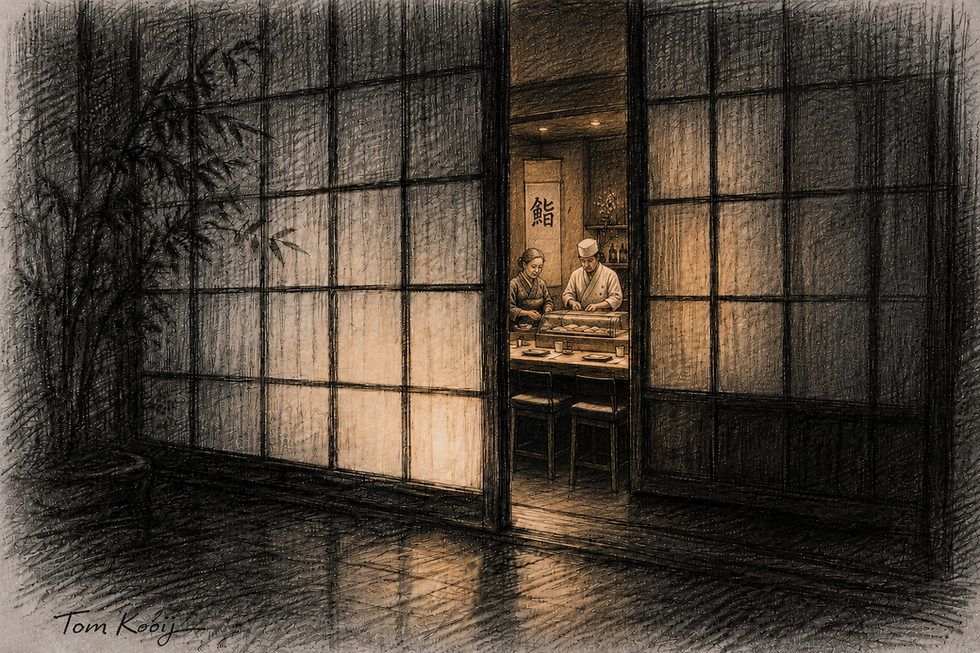
The woman behind the bar did not smile. She had not smiled when we walked in and didn't when we left. In another culture this might have read as indifference. In this room, at this sushi bar, it was something else entirely: a quality of attention that did not require the act of warmth because the warmth was already inside the attention. She had noticed everything. Without appearing to look up, she knew what we'd eaten quickly and what we'd pointed at twice. A second order of something appeared in front of me without my having asked for it. I had looked at it once on the board, with what I had assumed was adequate neutrality. She had read the look.
Japanese culture runs on a different level of care from the one the western hospitality industry has trained the world to expect. At its root is the concept of haji, of shame, and its counterpart, honour. But shame in Japan is not quite the western therapeutic wound. It is not simply the private ache of not feeling enough. It is social, relational, almost architectural: the experience of standing inside a web of obligation to your craft, your role, your customer, your teacher, your house, your name. To fail in that web is not just to perform badly. It is to dishonour the relationship.
That is why the woman behind the counter did not need to smile at us. In a western restaurant the absence of the smile would have been marked down as poor service. The training programme would have called it a missed opportunity. She was not withholding welcome. She was giving it in the only form that made sense in that room. Her welcome was in the knife and the rice and the way she noticed the next dish before we knew we were ready for it. She did not smile because the moment did not ask for charm. It asked for attention.
Attention, in that sushi bar in Shinjuku, was not a soft skill. It was a moral act. To serve badly would have been to dishonour the person in front of her. To pretend warmth while giving careless work would have been worse than rudeness.
Somewhere around the third drink, the couple sitting next to us, after sufficient staring, began to include us. The man, short in stature, had the energy of someone who had attended every Tony Robbins event that came to Tokyo and was applying the lessons with sincere enthusiasm and zero irony. He was delighted in the way of a person who has made a genuine decision to be delighted: rare enough that you notice it, and impossible not to respond to once you have. He spoke in enthusiastic bursts of broken English, arms animated, smile enormous. He came across as someone who would fill whatever room he was in with a warmth that appeared staged and yet was completely real at the same time.
His wife sat beside him in the way Japanese wives sit beside their husbands. Present, gracious, nodding at everything he said with a small bow of agreement that suggested either complete accord or a discipline of patience so long-practised it had become indistinguishable from it. When he spoke, she nodded. When he gestured, she smiled. When he leaned across to refill our glasses she watched him do it with an expression that may have been pride or may have been something else.
We were somewhere around the second round, in the middle of an attempt to interpret Japanese culture, conducted by a Japanese man whose own relationship to Japanese culture appeared to have been significantly shaped by an American motivational speaker. The ironies were layered. We were not entirely sober enough to fully map them. What I can say is that we were sitting in a room trying to read Japan, while Japan, in the form of this particular man, was sitting in a room having apparently decided that the best version of himself was somewhere between Shinjuku and a conference centre in Florida.
The drink we were given was shochu. Japanese sweet potato vodka. He ordered it in bottles. Not glasses. They arrived. One would appear. Then another. He pointed at our glasses. His wife nodded. He poured.
There are conversations that happen above language, and this was one of them. We had maybe a dozen shared words between us, most of them useless. But the room had its own grammar. Gesture, volume, eye contact, the little grunt a man makes when he means yes, absolutely yes, and possibly also I have decided you are now my responsibility for the evening. Like charades turned into a drinking game. So we drank, and somewhere inside the warm blur of the room, and the slow moral persuasion of the shochu, meaning began to assemble itself.
We went home a little legless. That wasn't the plan. We had planned to eat, embrace the culture, and get a reasonable night's sleep. What we got instead was a room that settled around us before we knew we needed settling. Before we ordered, the room had already said it: you are welcome to stay as long as you need, and you belong.
The man with the Tony Robbins energy gave it to us in one way. The woman who didn't smile gave it to us in another. Two entirely different cultural expressions of the same ancient thing. The body does not parse the cultural register, it only reads the questions underneath both of them.
Is this room safe? Do I belong?
That is hospitality. Not service, not warmth, not charm, not the polished theatre of making people comfortable while trying to extract something from them. Hospitality, in its deepest form, is the art of being seen without being made small, received without being managed, and held without being swallowed. It is the moment another human being enters an environment and feels, before a single explanation has been offered, that there is space for them here.
That is the whole thing.
Hospitality is older than service. It is older than restaurants, hotels, wine lists, front desks and scripted welcomes. Before it became an industry, hospitality was the human art of receiving another person in such a way that their body understood, before their mind had to ask, that their presence was not a problem.
Eleven Seconds is what I call that moment when transmission happens. The moment before language catches up, before strategy begins, before the agenda, the sermon, the performance review, the coaching session, the first note or drink or question or even apology. The room has already spoken and the body has already felt it.
Most human environments answer those two questions badly. Not with malicious intent or incompetence (in any visible sense anyway). The meeting runs on time. The footy change-room is professionally managed. The culture deck is polished to an exceptional standard, through Canva. Everything is technically correct. And yet, the room feels flat. Still the team sits back and cruises through. Still the performance lacks the last ten percent and the customer leaves politely and doesn't return.
Something is being withheld. The body knows it. Nobody has language for it, which means it can't be fixed, so it continues.
This is the essay about what is being withheld. And what I find is that it was first withheld, for most of us, much earlier than we can remember.
The First Room
The operating system is installed before we have words for it.
Before the boardroom or the classroom or the stage, there is the room where the nervous system learns what to expect from people, from safety, from belonging. Not learns in the way we learn a language or a skill but in the way the body learns to breathe: completely, before any instruction arrives, in a process the conscious mind never fully audits.
The child is already running a read that precedes any word by years. Edward Tronick, a developmental expert in neuro-behaviour, demonstrated this in 1975: mothers held blank expressions for two minutes while interacting with their children. Each child reached for reconnection first, then tipped into distress, then withdrew, and finally entered a kind of bodily shutdown you could watch move through them on the recording. Two minutes of the trusted face, blank. Their nervous system was already running, reading and drawing conclusions about their situation and environment.
Stephen Porges, the American psychologist, gave us the name for what the body is doing in those two minutes: neuroception. The continuous, pre-conscious scan of the environment for threat or safety, running beneath the level of thought, faster than any conscious decision. Before anyone in the room has chosen how to behave, the nervous system has already assessed the room and begun routing the body accordingly.
Safe: the social engagement system activates. The person becomes available for genuine connection, clear thinking, creative contribution.
Not safe: the body routes toward protection, and what the room gets is a defended version of the person, however capable, well-intentioned or professionally trained they might be.
This is not a metaphor. It is the biological mechanism underneath every room where human beings gather. Hospitality, understood correctly, is the precondition for the social engagement system. It is the eleven seconds that tell the body it is safe enough to be fully here.
Jane was eighteen the night her father moved out. She heard her mother's footsteps go from the kitchen to the front room to the kitchen again in a particular sequence she would, for the rest of her life, recognise in any house. Footsteps that meant something is happening downstairs you are not yet allowed to know about, but which is being arranged in this moment to become the structure of your life. Jane did not need the words. She had the read. It had been running in her body since she was a year and a half old, calibrated across thousands of micro-moments by two adults who had spent twenty years not quite telling each other the truth. By the time her mother called her down, Jane was already someone slightly different from the person she had been four minutes earlier.
This is what the first room does. It does not teach or explain. It installs. The child absorbs the emotional weather of the adults around them the way a building absorbs damp: invisibly, completely, until the structure shows the strain years later and nobody remembers when the water got in.
Dan Siegel, a clinical professor out of UCLA, called the active ingredient attunement: the steady, daily, attuned presence of an adult who reads what the child is actually feeling and reflects it back accurately enough that the child learns, slowly, that their inner life is real and can be borne by another human being. Attunement cannot be substituted. It cannot be replaced by provision, by education, by access, by any of the things well-intentioned parents reach for when they do not have the language for presence. It can only be given by a person present enough to give it.
Most first rooms give it imperfectly. The good ones give it imperfectly and repair. The others give it imperfectly and do not heal, and the child builds their adult self on top of the gap.
What fills that gap, compounding quietly across years, is shame.
Shame
Guilt says: I did something wrong. Shame says: something about me is wrong. Guilt is specific. Shame is structural. Guilt can be addressed by repair. Shame cannot be addressed the same way, because shame is not about the action, it is about the person, and the person cannot be changed by a better action without something far older and deeper shifting first.
Most people call it personality. Often it is just the body remembering the first room.
The child whose first room failed does not simply become sad. They adapt. They become performers. They build around the gap whatever the environment requires.
Some become over-performers: extraordinary, driven, impressive, running a background calculation in every room they enter about how they are being received. Some withdraw: technically competent, never fully available, present in the meeting without being present in the room. Some dominate: controlling the emotional weather of every space they enter because they could not control the weather of the room where it mattered most. Some manage: always reading other people's moods, always adjusting, always smoothing, always one step ahead of the next rupture.
Jane became a teacher, which is to say she found a respectable profession for the wound. A place where exhaustion could be mistaken for virtue. Where noticing everyone else's needs before her own could be praised as care, commitment, vocation, even love.
She had been loved, growing up, in the only language her father had. Provision. The ski trip. The first car at sixteen. The deposit on the unit at twenty-two. The handbag for her thirtieth from a shop in the city.
None of it was fake. That is the painful part.
Her father really did love her. He loved her with money, logistics, sacrifice, protection, the masculine religion of making sure the lights stayed on. But he did not have the language for sitting at the edge of her bed at nine o'clock at night and asking what was actually worrying her about school. He did not know how to stay in the room empty-handed. He knew how to arrive on Friday with a small box, perfectly wrapped.
So Jane learned, long before she had words for it, that love was something you proved by providing. Not received. Not rested in. Not trusted. Proved. The way to be loved was to be useful. The way to keep love alive was to keep giving. She has been doing this for twenty-eight years.
Jane tries to love her husband the same way. Organising. Anticipating. Remembering. Carrying. Planning. Noticing what needs doing before anyone else has even felt the inconvenience of it. The fridge is filled, appointments tracked, children's moods read, the edges of the house softened, the emotional weather absorbed and renamed as normal. This is the love she inherited: silent, practical, constant, unasked.
But now it all feels too hard. Not because love has disappeared, but because the system that taught her how to love is collapsing under its own weight. Jane is exhausted, and beneath the exhaustion sits something worse than tiredness: the slow horror of suspecting that the love she has been giving has not been recognised as love at all.
It has. That is the tragedy. Her husband receives it. The children live inside it. The home has been shaped by it. But Jane cannot feel the evidence because the wound will not let her.
So the more she gives, the less certain she becomes. The harder love is made visible, the more invisible she feels. This is no longer a response to the room she is in. It is a response to the room that made her. The first room. The room where love arrived wrapped in paper, but rarely sat beside her in the dark and asked what hurt.
Without meaning to, Jane has built an adult life around the same altar.
And then there's Harry, who became a withdrawer. His father was a property developer who did not speak about the building. His own father, a German immigrant carpenter from Hamburg, had taught him provision as a language: arrive on time, pay every bill, build something they can inherit. Harry's father did all of this and more.
When Harry was thirty-two, his father called him into the office one Tuesday afternoon and handed him an envelope. A contract and a gift of money. The combined value was, in the language of newspapers, considerable. In his own mind, Harry's father was being magnificent. The envelope said: you are sorted now. You can go and live your life.
Harry sat in the carpark afterwards for forty minutes. A takeaway coffee sat cold in the cupholder. He had bought it before the meeting and never touched it. What happened in that office would only become clear five years later. The closest his father would ever come to saying I love you had just been said, in the only currency he had ever been given. And the saying had also closed a door Harry had been waiting thirty years to walk through.
His father is eighty-eight now. The conversation will not happen. It cannot, because his father was never given the language by the carpenter from Hamburg, who was never given it by anybody, going back through three generations of men who built things rather than spoke about them. Harry comes home now at six fifteen with silence in his body. His seven-year-old hears the car in the driveway and comes to the front door, then stops three metres short. Somehow, somewhere, the boy has learned that three metres is the distance that does not provoke the silence.
Harry does not know his son has measured this distance. Both of them are inside it.
They hug. The silence resumes.
This is not a story about bad fathers. It is a story about first rooms that failed to install language, second rooms that inherited silence, and third rooms where silence became institutional. Every institution Harry will ever lead is running the same programme his father ran. Until Harry faces the gap, the programme continues.
And the gap is not only carried in families.
There is a CEO I know who took a role at a regional institution in a town that runs on relationships. He arrived after a thorough search process, four rounds of interviews, three reference checks and a final presentation to a committee of nine who asked him, in the way committees do when they have not quite settled on their question, how he felt about change.
He said he felt very good about change. He said it with the specificity that had served him in four previous organisations. He named the outcomes. He cited the work. Around the table, heads were nodding before he had finished. They were hungry for change, they said. Patient long enough. Ready now.
He started in October.
By February, something had shifted. Not in any formal conversation or meeting, but in the eleven seconds before them. In the way committee members arrived and settled into their seats without quite meeting his eye. In the way a long-serving operations manager began copying people into emails who had no business being there. In the way a room that had felt ready for him in October began, by March, to feel like it had never quite decided to let him in.
His changes were, by any external measure, defensible. They were the changes he had been hired to make. Three of the nine had cited them specifically in the final interview as what the organisation needed. But between interview room and institution, something no one had accounted for had run its own assessment.
The organisation had been in that town for forty-two years. Its culture had been installed by founders and maintained by people who had protected it across six previous CEOs, three of whom had been removed in circumstances the public record described as mutual agreement and town knowledge described differently. The chain was long and tight.
No one consciously decided to resist the new CEO. The chain simply ran its read.
Across hundreds of micro-moments from October to March, the organisation assessed him against every leader it had ever received, found the discrepancy, and began, as inherited environments do when discrepancy becomes undeniable, to protect itself.
He lasted twenty-four months. Officially, it was called strategic misalignment. His changes may also have been wrong for that institution, and that distinction matters. But wrongness of strategy and resistance from inherited environment are not mutually exclusive, and in this case the pattern, six CEOs, the same eleven-second assessment running from October, pointed somewhere older than strategy. The room had been running its first room since 1984, and a new CEO, however capable and however warmly welcomed in October, could not override forty-two years of inherited environment transmission by being right about the strategy.
The question the committee should have asked in interview was not, how do you feel about change? But: what do you know about the room you are entering?
And long before any CEO search began, the organisation should have been asked something more dangerous: What has this room been installing in people for forty-two years?
Until a room is examined, every new leader enters something older than an organisation. They enter a first room, with all the unresolved reflexes of a child. And the first room, as always, already has its own answer to the questions it has been asking since 1984.
Is this safe? Do I belong here?
Every Room
Every room where human beings gather is running the same operating system.
Boardrooms. Music rehearsal spaces. Classrooms, clinics, football clubs, houses of government. All of them are doing the same thing in every person who enters: answering, or failing to answer, the only two questions that have ever mattered.
Is this room safe? Do I belong here?
The ten percent that rooms consistently fail to produce is not a performance problem. It is a reception problem. A body that does not feel safe cannot access social engagement. What the room gets is the defended version of a person, however talented or well-intentioned. That is what was withheld from the CEO who arrived in October. That is what is withheld in every room that runs an old first room across a new person's face.
Hospitality is not the soft side of performance. It is the precondition for it. Without the safety genuine reception creates, you are not leading people. You are managing people who are managing themselves.
And the mechanism that changes this is not a strategy, a framework or a leadership development programme. It is one question worth asking about every room before formal work begins:
What does this room tell the body before anyone speaks?
The Recoverable Moment
Here is what makes this argument different from a trauma narrative.
Trauma says: the wound was done. Trauma is largely correct. The wound was done. The first room failed. The body remembers. The chain runs. All of this is true and all of it is visible in the bodies of the people in every boardroom, every changeroom, every rehearsal space, every regional institution that has been running its first room since whenever the founders set its tone.
But trauma, as a frame, can produce a particular kind of paralysis. If the wound was done early enough, and deeply enough, and by the people who were supposed to protect you from it, the implicit conclusion is that recovery is either a decade's excavation or an acceptance that nothing meaningful can change.
Neither of those is true.
Porges identified what he called the social engagement system: a neural architecture, running through the ventral vagus nerve, that governs the body's capacity for genuine connection, creative collaboration, and full contribution. This system is not permanently fixed by the first room. It is continuously responsive to the current environment. When neuroception reads safety, the system activates. The person becomes available in a way that no incentive programme or performance framework can manufacture. When it does not, the body retreats into defensive circuitry. Not as a choice. Before any choice is made. But the read can change when the room changes. The nervous system is not a verdict. It is an ongoing assessment. And assessments can be revised.
Donald Winnicott, the English paediatrician, established the mechanism for families: the good-enough mother does not need to be perfect. She needs to be reliable in the return. Perfection is impossible and, when attempted, is its own pathology. Reliable return is the entire job. John Gottman, another psychologist, established the same principle for marriages: the stable ones are not the ones that never rupture. They are the ones whose conflicts contain repair attempts, the small bid, mid-argument, that acknowledges the other person is still there. Repair is not the exception. For a room that works, it is the discipline.
Eleven Seconds does not solve shame. It does not argue with the wound. It gives shame a different ending. It receives the person before the wound has to perform.
The Read changes when someone slows down enough to see what is actually present, rather than what a programme says should be there. Welcome changes when warmth stops being performed and starts being transmitted, which are different things entirely. Repair comes faster when rupture is treated as inevitable and return as a discipline. The Chain can be interrupted when one person has faced their own first room honestly enough to stop handing it downstream without knowing.
You can change the eleven seconds.
When those eleven seconds change, an environment changes. When an environment changes, behaviour follows. Not the other way around.
What a room built on this understanding produces, in practice, already exists in the world.
You have heard it. Most likely you have felt it. You just did not know what you were inside.
Harmony
The West Australian Symphony Orchestra performs a hundred and seventy concerts a year in Perth. Perth: the most isolated major city of its size on earth, twenty-seven hundred kilometres from the nearest Australian city, closer to Singapore than Sydney. In performance, a room can do something most spaces never achieve.
It lifts.
For a while, music becomes more than the sum of its parts. People who arrived carrying their own concerns, messiness and separate schedules become, for the duration of an evening, one body responding to one thing.
Not because everyone plays the same note. Because everyone plays a different note, and those notes have found relationship.
Harmony is not sameness. It is not everyone singing at the same volume, in the same register, with the same emotional signature. Harmony is many different voices finding relational order. An oboe is not trying to become a cello. A percussionist is not being shamed for failing to sound like a violin. First chair has a different relationship to the music than third chair, and difference is not a problem to be managed. It is a resource to be conducted.
A conductor's job is not to flatten a room into uniformity. It is to create conditions where distinct voices can enter, listen, adjust, repair and return. The conductor is not the most important musician in the room. The conductor is the only person there who makes no sound at all. Not one note. The person responsible for the entire environment contributes nothing to the product. Every leader thinks they are lead violin. They are not. They are standing with their back to the audience, producing nothing, so everyone else can produce everything.
This is what Eleven Seconds looks like at the scale of a team.
A great team is not a group of talented individuals managed toward a common outcome. It is a room where difference can come into harmony without being erased. Where the person who reads things differently is not a disruption but a resource. Where someone contributing in a register unlike the dominant culture is not required to mimic that culture in order to remain. Where rupture is not the end of the performance, but the moment a room repairs and returns to time.
Most teams never achieve this because many leaders have never experienced it in their own first rooms. Early on, they were required to sound like other instruments. They learned that belonging required a particular note, and now conduct their own rooms with the same demand. The diversity initiative fails. Psychological safety comes back flat. Talent leaves. A consultant arrives with a framework for inclusive leadership that never reaches the first eleven seconds of the first meeting, where every body is running the read, and the newcomer's nervous system is asking the only two questions that matter.
Is this room safe? Do I belong?
And without knowing it, the room fails to answer.
The orchestra works because the conductor has given difference permission to belong. The team fails because the leader, never received in their own difference, cannot give what they never received.
Purpose
What gets released, when the room is finally safe enough, is not just contribution. It is something closer to vocation.
We called it shame earlier. Not guilt, which is about what you did. Shame is about what you are. The body's suspicion, installed in eleven seconds in the first room, that something about you is fundamentally insufficient and that the room, if it looks closely enough, will find it. It runs as background process in Jane's kitchen, in Harry's carpark moment, in the boardroom. It is not a mood or a character flaw, but it is a tax on every contribution, every creative risk, every moment of genuine offering. Most people call it personality. Often it is just the body remembering the first room, and in most rooms, the tax is never lifted.
When the room gives shame a different ending, when it receives the person before the wound has to perform, the bandwidth comes back. The question changes. From: am I enough to be in this room? To: what is this room asking of me? That is the entire distance between performing a career and living a vocation.
The person carrying shame cannot be fully at purpose. They can be impressive, effective. They can build extraordinary things and lead real change and have their name on buildings. But they can also, simultaneously, be spending a significant portion of their energy maintaining the gap between who they actually are and who they believe this room requires them to be. That energy is not available for the work. Not for the creative risk that changes an industry. Not for the hard conversation that changes a culture. Not for the quality of presence that makes a team genuinely exceptional rather than merely competent. It is available only for the performance. And the performance, however brilliant, is not the same thing as the work.
Purpose requires presence. Not the managed presence of a person who has decided which parts of themselves are safe to bring into the room. The actual presence of a person who has been received, in at least one room, in enough of their fullness that the performance is no longer the price of admission.
This is why the wellness movement matters. And why so much of it fails.
It matters because the hunger it addresses is real. People are running shame that was installed before they could speak, in rooms they had no choice about attending, by people who were themselves running shame from their own first rooms. The hunger for a second chance at that first moment, the room where you are received rather than assessed, seen rather than processed, is one of the deepest hungers in the western workforce right now. It explains the retreat, the therapy, the coaching, the meditation app, the breath-work facilitator, the leadership development journey, the sabbatical, the career pivot, the increasingly desperate search for a room that will finally receive the part of you that the last thirty rooms required you to leave at the door.
It fails when it treats shame as a personal condition rather than an environmental one. When it teaches people to manage their own nervous systems while the room they return to on Monday has never been through a full check-up (rubber gloves and all).
The retreat is beautiful and the work is real. The room is safe for three days. Then Monday arrives and the first eleven seconds of the first meeting tells the nervous system everything it needs to know about where it actually is.
The retreat evaporates within a fortnight.
The wellness that works changes the room. Not the individual.
This is the paradox the wellness movement stumbles over. The room cannot change without a person who has faced their own first room. And the person cannot fully face their own first room without a room safe enough to do it in. The loop is real. The entry point is wherever you are standing.
Hospitality is not a secondary concern, not a quality-of-life feature, not a culture initiative. It is the gate through which purpose must pass. Without it, what follows is performance. With it, what follows is contribution of a different order entirely.
The condition that makes it possible has a name older than any framework we have put around it.
The New Hospitality
The woman behind the bar in Tokyo did not have a hospitality training programme. She did not have a scripted welcome or a service standard defining appropriate eye contact duration. She had the read, and in the culture of her room, a welcome that preceded explanation and outlasted the meal. She expressed it through precision and attentiveness and craft. Through the second order appearing before it was requested. Through the absolute quality of her attention to the room and to the people inside it. We did not speak her language and she did not speak ours and none of that mattered, because the body had already understood, in the eleven seconds after the door opened, that this was a room where being a stranger was not a problem to be managed.
Hospitality is not a sector. It is a human operating system. It is the craft of making another human being feel seen, received and safe enough to participate. That craft belongs to the restaurant, but it belongs equally to every other room where human beings gather and attempt to do something together.
Every institution that deals in human beings is a hospitality institution, whether it knows it or not. The hospital where the patient feels processed before they are received. The school where the student knows, in the first week, whether this is a room where their particular kind of intelligence will be valued or required to disguise itself. The football club where the young player reads, in the first week of preseason, whether this is a room that can hold him or one that will require him to become something else in order to play. The organisation that tells a new CEO in October that it is ready for change and tells his body something different in the eleven seconds before every meeting from February onward.
All of them are running eleven seconds. All of them are answering the two questions in the body of every person who enters. All of them are either receiving people or withholding reception, and the difference between those two things is the difference between a room that merely functions and a room that is genuinely alive.
The organisations that will matter in the next decade are not the ones with the best strategy. They are the ones that understand what happens in the eleven seconds before strategy begins. The leaders who will matter are not the ones with the most impressive credentials. They are the ones who have faced their own first rooms honestly enough that they are no longer transmitting the wound downstream through every institution they build. They are the ones who can read a room and change it. Welcome a person and mean it. Repair when they get it wrong. Hand something different down.
Hospitality is the precursor. Everything else is downstream.
The work begins in specific rooms, at specific tables, in the specific eleven seconds that change a specific person's understanding of whether this world has space for them.
At Jane's dinner table tonight, her daughter is eleven. An only child.
The daughter is reading the room with a precision Jane has never quite had words for. She knows, before her father has put his keys down, what kind of Friday he has had. She watches her mother across the kitchen island and sees the small tightening around the eyes which means the day has been hard. She does not call it that. She has not yet found the language. She walks over to her father, slips her hand into his, and asks him about the footy score. He smiles for the first time since he walked in. The smile lasts about forty seconds before his face does the next thing. She has eleven minutes before her mother calls them to the table. She is making a plan.
The plan involves a joke about the family dog at exactly the point in the meal where her parents would otherwise stop talking. It involves bringing up the school play. It involves putting her hand on her father's arm at exactly the right moment at dessert, since she has noticed the squeeze produces a particular response in her mother which changes the mood for the rest of the night. She has a notebook under her mattress with a list of things planned for this week. The brownies on Wednesday. Standing by the door at bedtime to encourage them to kiss, even on the nights they do not want to.
There is nobody else. No sibling to absorb some of the weather, to distract a parent with a question at the wrong moment, to sit beside her and give her, by their presence alone, the sense that the room's weight is shared. It rests on her entirely, as it once rested entirely on Jane, in a different house, many years ago, under circumstances that produced the same child: the one who learns to read a room before she can name what she is reading, who builds her sense of worth around whether the two most important people in her world are still safe with each other, who believes, in the part of her the notebook cannot reach, that if she just gets it right, the room will hold.
She is eleven years old and is exhausted, but she does not know this is exhaustion. It is just the way she thinks people are.
What this child needs is the conversation Jane cannot yet have. The one that says: "I see what you have been doing. This is not your job. The marriage is not yours to manage. You get to be eleven." The repair that would shift this chain is a small one. A Saturday afternoon in the car, or on the back step, or on the edge of her bed. Six sentences. The conversation will not come. Jane is still inside the loop she did not build, and the loop does not contain the capacity to see itself, and so the chain continues.
Six streets away, in the house with the unpainted picket fence, the granddaughter who is four and a half is putting the salt back on the shelf in the pantry where she found it. Nobody asked her to. She watched her grandfather notice the salt was on the counter and saw him pause for a second before reaching for it. She registered the pause. She walked across and put it back. Her grandmother saw her do it and smiled without saying anything. The smile lasted half a second. The granddaughter, in a place she has no words for, registered that she had done a small good thing in a room that saw her, and the registering became part of her architecture, and it will stay there for sixty years.
Two children. Same eleven seconds. Different chains.
And over at the Perth Concert Hall, an orchestra is tuning.
The musicians arrive, find their chairs, open their instrument cases, begin the small rituals of preparation that every musician develops across years of returning to this moment. The oboist runs the reed across their lower lip. The cellist tightens the bow. The percussionist checks the kettledrum. The room fills not with silence but with the particular productive noise of many different instruments finding their own pitch before the conductor walks in.
The conductor arrives. The room settles. The baton lifts.
In the eleven seconds before the first note, something happens. The instruments are not yet playing. The audience is not yet listening and the music has not begun. But the room has already spoken. The baton has already communicated: this is a room where you are required to be fully present, and where your particular voice has a place in what we are about to make together. The body of every musician has already heard it. The read has already run. The welcome has already been given.
Then the first note and then the harmony.
Many different voices finding relational order. Not sameness or uniformity. Each one giving what only it can give, received by the space, held by the structure, tuned by the discipline, free because the environment has made it free.
That is the whole argument. Not therapy or culture consulting. Not the scripted welcome and the service standard. The environment that makes it possible for a person to bring what they actually have, rather than pretending to have what the room requires them to have, and for the difference between those two things to become, in the hands of a conductor who knows how to hold it, something that nobody could have produced alone.
I wrote this essay because I have stood at the edge of enough rooms across enough decades to know the difference between a room that is functioning and a room that is alive.
The difference is not talent or strategy. It is not leadership style or cultural values or organisational design.
It is eleven seconds.
Eleven seconds when someone walks in and the person behind the bar stops what they are doing and turns. Eleven seconds when the child comes home and the parent puts down the phone. Eleven seconds when the new player arrives at training and someone who has been there for years walks across the room to say welcome, not because the protocol requires it but because the room has made it natural. Eleven seconds when the musician lifts the bow and the conductor lifts the baton and the room, for one suspended moment, holds every difference inside it at once before the music begins.
All it takes is eleven seconds and then the room is different and the people are different. And then what they make together is different from anything any of them could have made in a room that withheld the welcome.
Every adult begins in the first room.
The questions the body asks have not changed. They are the same two questions the child asked in the kitchen forty years ago and the same two questions you will ask in the next room you walk into.
Is this room safe? Do I belong?
The question is not whether we transmit something.
We always do.
The question is what we are transmitting.
---TK
Appendix: The diagram below maps the four-stage operating system this essay describes. The Read. The Welcome. The Repair. The Chain. Four stages, each one preceding language, each one laying down the architecture of every adult room which follows.
Before we lead rooms, we are formed by them. Every adult room begins in the first room.


Comments