


Caught, Not Coached: How Game Sense Is Built. A Field Note.
- Tom Kooy
- 3 days ago
- 9 min read

Updated: 2 days ago
Companion to the essay Why We Can't Read Each Other Anymore (Kooy, July 2026). Both pieces ask the same question: what happens to the human capacity to read other people when it stops being practised in person.
Every footy program has a player like this. Not the quickest, not the best in the time trials, but always in the right place a half-second early. The ball turns up where they already are. They feel the play move before it moves. Ask them how and they can't tell you, because it never went through language. It lives in the body.
Pierre Bourdieu called that the feel for the game, le sens pratique: an instant, bodily read of where the play is about to go, laid down by thousands of hours inside it and available in none of them by thinking. Sport has its own word for it, game sense, and its own science for how it forms. The constraints-led coaches and the ecological-dynamics people have spent decades showing that this kind of skill is not something you can install by instruction alone. It emerges. You shape the environment, the athlete solves it, and the reading grows out of the solving. Nobody hands it over on a slide.
This is the problem, as we are quietly stripping the environment that grows it.

I usually write about this in ordinary life, where the read goes unmeasured. Sport, which has a special place in my heart and my thesis, is the exception. Here it gets scored every weekend, and the gap between a team that has it and one that doesn't shows up on the ladder. Same argument, somewhere you can actually see the cost. It is also the argument firms could consider, and I will point at that parallel where it is sharpest.
What builds the read, and what we're removing
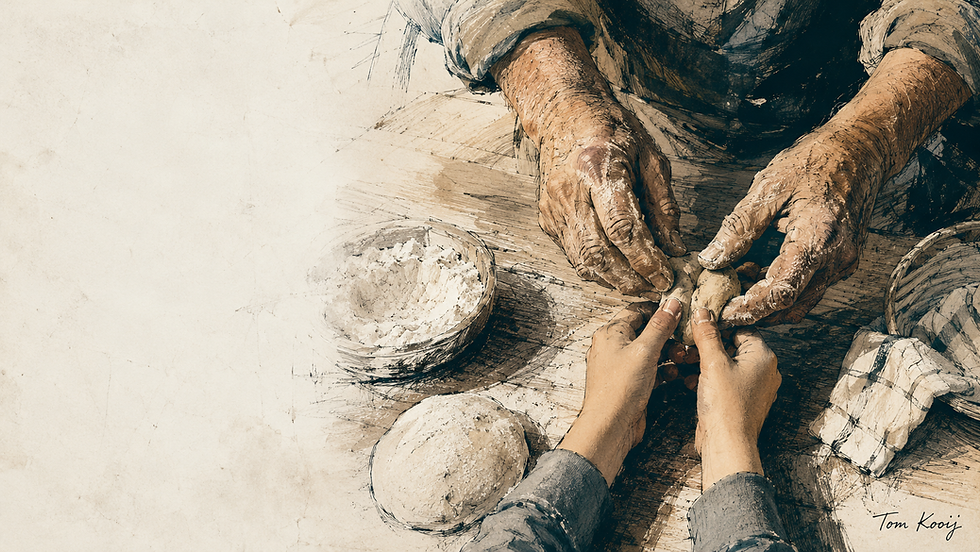
The feel for the game is caught the way anything in the body is caught: in reps, in chaos, in the presence of other people doing it alongside you. The backyard game with no adult in sight. The years of unstructured play. The senior pro you trained next to until you started moving like him. The bus, the drive home after training, the shared meal where a group slowly learns each other's timing without being taught it.
I think of a footy club I know, the men's and the women's teams both, around a couple of barbecues on a cold Thursday night in the dead of winter at the team's HQ. Sausages and steak going on, a tray of onions cooking down low and slow until the few kicking a footy on the other side of the oval smell it, the protein everyone's been told to load, balanced, by a seltzer or an Emu Export. Nobody is running a training exercise or on a phone. But that is precisely where a group turns into one nervous system: the muck-around, the piss-take, the story told for the fortieth time, two squads learning each other's faces until they can read them in the dark. You cannot force or schedule that outcome. You can only lay the fire and get everyone standing around it.
Now look at what a modern setup does to all of that. It individualises everything: your program, your load, your recovery, your screen full of your own numbers. It fills the dead time with a phone instead of a card game. It over-cues, feeding the athlete so much external information that the internal read never has to fire. It churns the list, so the senior-to-junior handover keeps getting cut before it finishes. Every one of those is defensible on its own. Stacked together, they thin the exact soil the reading grows in.
Now, I don't want to be overly didactic or preachy, it is easy to sound like an old Millennial pining for the good old days. The science and the data and the individualised loads have made athletes healthier and more available, and I am not arguing to throw any of it out. I am arguing that it carries a cost nobody is pricing, and the cost is game sense.
What about in a corporate firm? A young lawyer or a graduate adviser grows the instinct the same way: in the room while a senior reads a client across the table, re-running the meeting in the car afterwards, sitting through a few hundred before they can feel one turning. And the same forces are thinning it. The work goes home to be done alone. The junior gets siloed into a narrow specialty. The precedent bank and the model and the AI draft do the reading for them. Each is efficient on its own. Together they starve the judgment that only ever formed in person, next to someone who already had it.
What the flag-winners know
There is a difference between a coach in their third year and one in their fifteenth, and it is rarely tactics. The long-tenured ones, the ones who have actually held the whiteboard on the last day in September, tend to land on the same short list of truths. Most of them are about leaving things alone.
The first is continuity. You do not grow a group that reads each other in one pre-season. It takes years of the same bodies in the same rooms, which is why the clubs that sustain success are the ones that refuse the annual teardown. Fremantle have gone about it the same way, holding a core together and letting it mature this season. But the cleanest example over the long haul is Geelong. Chris Scott is into his sixteenth season in the chair, the longest current tenure in the league, and across that run the Cats have reached the finals in all but a couple of years, built on the unseen skill: holding a core together and folding new recruits into a culture that already exists, rather than rebuilding from scratch every three years. When a down season arrived and the outside noise called for a clean-out, they held their nerve and recalibrated instead. The read you are chasing is a function of time, and every time you churn the core, you set that clock back.
The second is that your senior players do more of the coaching than the org chart admits. You see it at training: a first-year starts making the same early movement as the veteran beside him, a half-step before the ball, and nobody taught it to him, he has just watched it happen fifty times. The standard gets set by the ones who have already caught it, and the young ones catch it off them. Coach your leaders hard, then let the leaders coach the room. A culture handed down player to player outlasts anything you put on a screen in a meeting.
The third is the hardest, and most coaches only reach it after they have won one: say less. Not no cues, the right ones. A cue that sharpens a read is coaching; a cue that hands over the answer is a read the player never had to make. Feed a group answers all week and they have less to draw on in the last quarter, when the structure breaks and the game turns into pure reading. The flag gets decided in the minutes the analysts can't document. You spend the week building people who can think in those minutes, then you get out of their way.
None of this is a clean system, and the three pull against each other, almost a tension. Continuity says keep your core, but legs age, and a list that never turns over gets old and slow, so you are always guessing when to hold and when to refresh. Say less, except the kid in his first season sometimes needs you to say the exact thing. The craft is knowing which player, which week, needs which. Anyone who sells you a formula for it hasn't done the job.
So, in practice
Beyond the big calls, a few things you can build into the week.
Design for chaos, not for tidiness. Small-sided games, live constraints, situations messy enough that the athlete has to read and solve instead of running a called pattern. A drill that removes the decision removes the learning.
Protect the co-presence. The change-rooms, the bus, the warm-up, the meal. That is not downtime wrapped around the real training. For the group's feel for each other, it is the training. Guard it the way you guard time-trial results.
Keep the data in its place. GPS tracking data, vision, the numbers: all useful, none of them the read. The day an athlete trusts the screen over the flinch in their own gut, you have trained out the thing you were trying to grow.
For the athlete
The instinct that separates good from great was built by presence, and it stays sharp the same way. Every hour siloed with your own screen is an hour not spent catching the read off the people around you.
Being in the group is training. The bus, the meal, the muck-around before the session.
That is where you learn to feel where your teammates are without looking, which is most of the game at the top level. Skip it to sit on your phone and you are skipping reps that never show up on the GPS tracking unit.
And when the read comes, when your body knows, before your mind does, back it. The screen will always be half a second behind the room.
The scoreboard version
Watch any side that has it play one that doesn't. Same talent on paper. One is a set of individuals executing their roles. The other moves like a single body, the pass hitting the space a runner is only just leaving for, the whole line lifting with nothing called. That difference is not a collection of skills. It is a group that has read each other so many times the reading has dropped below thought. You cannot buy it in the trade period and you cannot install it in a camp. It gets caught, or it doesn't.
Every good coach knows the difference between a team that's been picked and one that's become a room.
The balance-sheet version
In a law firm or an advisory practice, the stakes are different from sport but the faculty is the same. Judgment and trust are not a by-product of the work. They are the work. As the drafting and the modelling and the research get commoditised by the machines, the read is what's left: the partner who hears what the client isn't saying, who feels the room and notice the exact inflection point before the words come, who knows when to push and when to let the silence do it. It's the EI (emotional intelligence) and SQ (social intelligence) built over time.
That read is the firm's real balance sheet, and it sits on no other one.
Now, you cannot hire that read in, and you cannot train it in a workshop. This is the thing the AI-era talks gloss over. Nobody's induction program teaches a graduate to read a boardroom, or a grieving family across a desk deciding what to do with an estate. It gets caught the same way it is caught in a football club: by sitting next to someone who already has it, in the room, on the drive, at the client's table, for years, until it seeps in. It is why trust runs on time, too. Most banks could learn a thing or two from this, but a client who has had four relationship partners in six years never lets any of them all the way in. The practices that last are the ones that keep learning together, in person, faster than the world outside them changes. A firm that sends its work home to be done alone, that prices everything in billable hours and nothing in what the associates absorb by being there, is quietly optimising away the only thing it actually sells.
The most pristine version of the advice is incredibly cliché, and every leader worth working for already lives by it. "To be interesting is to be interested in people." The rainmakers in every firm I have been part of are rarely the slickest technicians. They are the ones almost helplessly interested in other human beings, who remember the client's daughter's name and genuinely want the answer when they ask how she is going. That is not a business-development tactic you bolt on. It is a way of being, and your real job is to protect it in your people, not slowly manage it out of them in the name of efficiency.
Which leaves an instruction simple enough to put on the wall: 'Be the one who is interested. Not the slickest in the room, the most interested in it.' Bring back the long lunch. Sit in on the meeting you could have skipped. Take the graduate to the client and let them watch you read the room. Put both teams around the same barbecue on a cold Thursday night, because the fire and the onions and the wine are not the reward for the work. For the thing you are really building, they are the work...
–TK

header.all-comments