

Because You're Worth It

Updated: Aug 10
Three in the morning. The ceiling again.
You come to know the exact colour of your own ceiling at three in the morning, in the year you bet everything. This is not a figure of speech. It is the real risk, the one where you signed the thing, spent the money, stood in front of a room full of people who had families and financial commitments and quiet hopes, and told them to follow you. And now you lie in the dark and do the sums, and the sums do not improve no matter how many times you run them.

The night before, I had cooked dinner for myself, which is its own kind of confession. Scotch fillet for one. Tolpuddle Chardonnay to start, Tasmanian, cold and tight and costing more at that time then many from Tasmania ever had. Then a Cape Grim scotch fillet, medium rare, the broccolini charred and salted the way I like it, and a bottle of Woodlands 'Thomas' Cabernet, because it has my own name on the label and the narcissism, I am well aware, is real. A grown man toasting himself with a wine that carries his own name. As, somewhere I had read that you should mark the small wins, and thirty years ago an advertising executive taught a whole civilisation that three words would settle the ache. "Because you're worth it." L'Oreal. I ate it slowly and I waited to feel worth it. I felt the char, the fat, the long tannin, the money going down. I did not feel worth it. I felt like a man eating an expensive apology to himself, alone at his own good table.
And while the wine was doing its work, I was brought into a place of appreciation of the effort of what I was consuming. Every one of those labels is a family. The Watsons put cabernet in the ground at Wilyabrup before I was born and named their best bottles after their own, so that a man could sit in the dark decades later drinking their surname and toasting himself with it. Two of them behind the Tolpuddle, one the first in this country ever to call himself a Master of Wine, betting a working life on cold dirt at the bottom of the world. A family out on the wind-scoured tip of Tasmania raising cattle in the cleanest air anyone has ever measured. Every bottle on that table was somebody's twenty-year risk, somebody's own ceiling at three in the morning, somebody's expensive apology that eventually, maybe, came good. I was drinking other people's nerve. It was the only kind I could keep down that night.
Also, there is a part the founder myths leave out, the one the feeds never show. Nobody believes in you. Not really, not the way the story promised they would. Belief turns out to be a fair-weather sport. Easy to hand a person on the way up, quietly taken back the moment the climb starts to look like it might be a fall. Belief has a temperature, and you lie there and feel the room cool. And here is the darker part, the one you do not see coming. The last person to stop believing is the one whose belief you cannot survive without. Yourself. That is what actually does the damage. Not that they lost faith in you. That somewhere around three in the morning, so did you.
Nobody says those words out loud. That is the worst of it. If they came at you straight you could argue back. Instead it arrives as a silence at dinner, a question that is really an accusation, a look held a half-second too long. The doubt of the people closest to you does not knock. It seeps...
Let me say what someone in this line of work should. Every founder I have known, every investor who has put real money on a real outcome, every person who has stood in front of a room and told it to follow him, has at some point flirted with a vice. A bottle opened a little earlier each week. A habit, chemical, chocolate or otherwise, that started as a reward and became a rule. Some small medicinal escape pressed up against the rollercoaster to keep the whole thing from shaking itself apart. Nobody plans it. It comes like a reward, a treat... You have earned this. After-all, "You're worth it." And it works, for exactly as long as it takes to fall asleep, which is the only mercy it offers and the whole of its cruelty.
I have flirted with it. Most of them have. The ones who swear they never have are either lying, or they have not yet risked enough to need to, but the escape was never the disease. The escape is the symptom. The disease is that there was no one in the room, and a good bottle was the closest thing to company a man knew how to pour.
And that is where the fun really starts. As that is the night you find out you are on your own.
Not lonely, alone, and they are not the same thing. Lonely is a mood. Alone is a fact. You lie there and you ask the ceiling the only question that matters, was it worth it, and the dark does not answer. That is the cruelty of the dark. It does not argue with you. It does not reassure you. It holds still and lets you listen to your own pulse and waits to see what you are made of.
Rudyard Kipling wrote the manual for that room, though he did not call it that. An Englishman born in Bombay in the last century before last, the one who gave the world The Jungle Book and then, in 1910, a short poem called, "If". Thirty-two lines of advice from a father to a son, the most quoted poem in the language, the one framed on the wall of every gym and every headmaster's office, the one everyone can recite the first line of (and maybe one or two more) and almost no one can actually live:
"If you can keep your head when all about you, are losing theirs and blaming it on you,
If you can trust yourself when all men doubt you, But make allowance for their doubting too.....Take everything you have won, pile it up, put it on one reckless turn of pitch and toss, and lose it, and go back to the beginning, and never breathe a word to anyone about your loss." - If, Kipling.
I have read it at three in the morning. It does not make the sums improve either.
I learned the shape of that aloneness a long way from here. I spent time in New York recently, and sometime people think the size of a place is the same thing as the size of a life. New York teaches you otherwise, and fast. A person can be completely alone in a crowd of eight million. Nearness is not company. You can stand shoulder to shoulder on a subway platform with a thousand strangers at rush hour and be as alone as a man on the moon. That is the New York kind of loneliness. Density. Too many people, and not one of them yours.
I am writing this from Perth. Which is the other kind entirely.
Perth (they like to say), is the most isolated city of its size on earth. Two and a half million of us, and the nearest city of any size is two thousand kilometres away, across a desert that does not much care whether you make it. We are closer to Jakarta than to Sydney. You can stand on a beach here at dusk and know, in your body, that there is nothing between you and Africa but water. That is the Perth kind of loneliness. Not an absence of people. There are people, two and a half million of them. It is the distance around the whole place, the space that gets into everything, the sense of being a long way from anywhere no matter how full the room is.
Two opposite geographies. It's the same at three in the morning. The ceiling is the ceiling whether the city outside your window holds eight million or whether the next one along is a day and a half through nothing. I used to think it was the distance that made it lonely out here. It is not the distance. It is that out here the distance stops being an excuse. In New York you can at least tell yourself the crowd is the problem. Here there is no crowd to blame. Just you, the space, and the question.
Twenty years on from that ceiling, I sit in rooms for a living. Not the boardroom-strategy kind, with the deck and the whiteboard and the offsite. The other kind. The kind that happens after the lawyers have sharpened everything, and before anyone in the family has said the true thing out loud.
I have sat with an eighty year old man who built something from nothing across sixty years, a fortune, a dynasty, and who could not say to a single living soul that he was frightened of dying, and more frightened of what his children would do to each other over the carcass. He had commanded rooms of a thousand people. He could not get that one sentence out. So he said it to me at his own kitchen table, a bottle of scotch, we had almost consumed entirely together, at an hour when men his age are meant to be asleep, and then he looked out the window like he had confessed to a crime.
I have sat with the oldest daughter. Thirty years she has waited for a chair that keeps not being offered. She loves his father and is quietly rotting from the waiting, and cannot say either of those things out loud, as in that family you do not say things, you imply them, across decades, over the good ham at Christmas.
I have sat in the divorce that was never really about the marriage. In the directorship battle that was not about the company at all, but about a wound one brother took in 1987 that had been waiting patiently, for thirty-odd years, for a legal instrument to finally speak through.
They call it, "wealth transfer". A phrase used as if it were plumbing. As if you could run forty years and three generations of love and grievance and disappointed hope through a trust structure, and not have it come out the far end as a war...
None of it is ever about what the paperwork says it is about. That is the first thing you learn, and it takes about a thousand rooms to learn it. The paperwork is just the respectable clothing the pain puts on to be allowed into the room.
And the reason they let me sit in it, has nothing to do with a CV (as if it did, I wouldn't be in it at all). It is that I have laid in that bed. I know the exact colour of that ceiling. When an eighty year old patriarch is working out whether to hand a much younger stranger the thing he has never said to anyone, some old animal part of him is checking one thing and one thing only. 'Has this one bled?'. And he can smell it on me. You cannot fake that and you cannot read it in a book, and you certainly cannot buy it by the bottle, not even the good one with your own name on the label. You earn it on your own ceiling, on your own worst night, asking if the risk was worth it while the dark declines to comment...
The Demon, Revisited
In March, I wrote an essay about what I called the oldest demon. The fear of being seen and found wanting. I said everyone carries it, that most people have carried it so long they have stopped noticing the weight, that it becomes the hum underneath everything.
I still think that is true. But I have sat in these rooms for a little longer after I wrote it, and I have come to think I had only half of it.
Here is the half I missed. The people I sit with are seen constantly. That is the entire condition of their lives. Maybe photographed, quoted, definitely deferred to, watched across the boardroom for the flicker that tells the room which way to jump. The patriarch is seen by the family and staff. The founder is seen by the whole market. They are, by every measure the world keeps, the most seen people in any room they walk into.
And not one of them has been 'met' in years.
As being seen is not being met. Seen is surveillance with better lighting. Seen is the room reading you for what it can get. Met is someone setting all of that down, looking at the person underneath the certainty, staying there, and needing nothing back. The successful drown in the first and starve of the second, and the cruelty of it is that the drowning looks, from the outside, exactly like being fed.
Being seen is the best table in the house. The one by the window everyone notices when you walk in, the one the maitre d' or manager saves. And eating at it alone, while the whole room watches you chew and calls it success.
So the demon does not die as they climb. It grows. Every rung adds watchers and subtracts witnesses. The higher you go, the more eyes on you and the fewer of them are actually seeing you. And the fear, the one that says if anyone truly looked they would find you wanting, never gets disproven, because you never let anyone close enough to run the test.
You cannot be found wanting if you are never actually found. You also cannot be found worthy. You just carry the question, unanswered, into every room, for thirty years, until it is three in the morning and you are asking the ceiling and the ceiling is not the sort to answer.
The demon does not feed on failure. It feeds on unbroken visibility. And it has never been fatter than it is now, in the age of the personal brand, when everyone is seen all day and met by no one.
And do it here in Perth, it gets worse, not better. Perth is not small. Two and a half million people. But the top of it is. The rooms that actually decide things are few, and they overlap, and everyone in them has known everyone else in them since school, or since the first deal, or since the divorce, which half the western suburbs worked through over dinner. The city is large. The world at the top of it is a village. Which means that up there, where you sit, you are not one face in millions. You are a name people say to each other. You are seen more completely, and more relentlessly, than a stranger in a bigger city ever could be. And met, if anything, even less, because the more the room already knows about you, the more carefully you hold your face, and the fewer people are left in it who have not quietly taken a side.
A big city lets you vanish into the crowd. The small world at the top of one puts you on the mantelpiece. Neither of them meets you. One just watches more closely.
Who Welcomes the Host
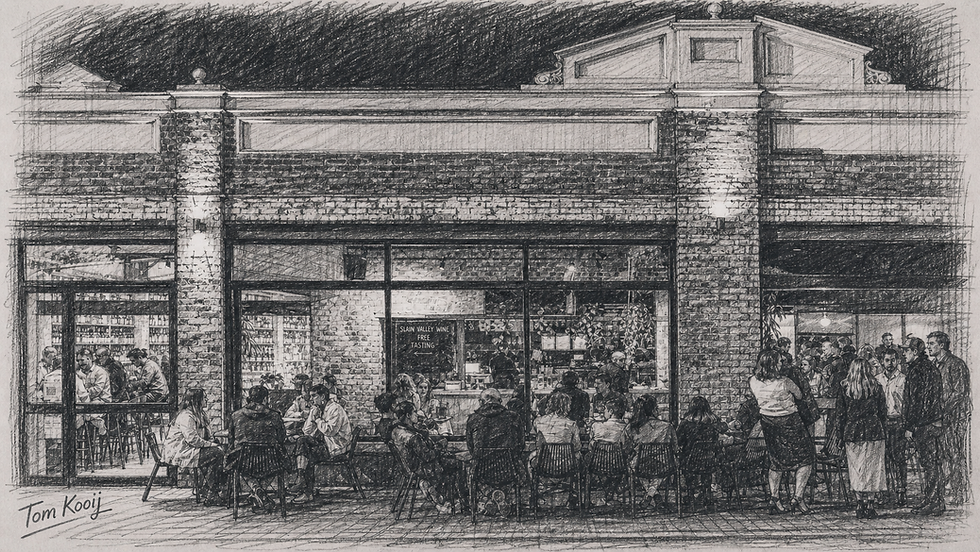
I wrote another piece, a much longer one, about Besk on a Friday night. About the welcome. The eleven seconds a good bartender gives the woman who walks in on her own, the way it settles her nervous system in a way no algorithm can reach. I argued that the welcome is the rarest thing left in an age of cheap intelligence, and that the source of it is always the leader. The operator does the inner work to be sturdy, it transmits down the chain, and the guest feels a room holding them without ever seeing who built it.
I stand by every word. But there is a question I did not ask in that essay...who gives the leader the eleven seconds?
The bartender can pour with both hands as someone, somewhere back down his own life, poured for him. The operator can hold the room as she is, herself, held. That is the theory. It is a lovely theory. Now walk into the kitchen at midnight, after service, and find her alone at the corner table with a glass of red and the night's takings not quite adding up, and ask her when someone last gave her the eleven seconds. Ask the founder who spends every waking hour making his people feel safe when he himself last felt safe. Nobody in these rooms has an answer. That is the whole of it.
The room went home warmer than it came in. That was the point. That was the craft, working exactly as designed. The chef plated three hundred covers tonight and did not sit down to eat one of them and the manager stands in the wreckage at midnight, the last one in the building, holding a warmth she spent the entire night giving away and did not once receive.
The people who are the third place for everyone else have none of their own. The ones who do the welcoming are the least welcomed people alive. They are the source, and the source is running dry, and everybody keeps drinking.
The host should not have to eat alone.
So what do they need, the people who seem to have everything. Not advice. Advice is everywhere, advice is free, and mostly it is worth exactly what you pay for it. Something rarer than that. One chair in the room that wants nothing from how it ends. No inheritance. No directorship. No side in the divorce. No stake in which way you jump. Just someone who has been to the bottom of his own night and climbed back out, and can sit with you at the bottom of yours without needing you to hurry up and be fine.
The demon dies the first time someone truly looks and does not flinch. Not seen. Met. Found, and not found wanting. It takes about eleven seconds, and it takes someone with no stake in the answer. Most people at the top of most things have never had both at once.
---
Was the risk worth it. I still do not know. The dark still will not say. But I stopped asking it alone. And now I sit in the dark with other people, at their kitchen tables, at the hours where the dark night of the soul rises, and I give them the one thing the climb took and never handed back. Someone who sees the whole of them, the numbers that will not improve and the sentence they cannot say to anyone who loves them, and does not look away.
And sometimes, when the worst of it has finally been said and the room has gone quiet, we eat. Nothing elaborate. A good steak, salted well, a bottle worth opening. But not alone. Never. Because the food was never only food. It is the oldest reason we have to sit down across from each other and stay.
That, in the end, is the whole of the job...
--TK

Comments