


Pics or It Didn't Happen.

On trust, belonging, and the habit of proving 'we were there'...
The Toast
When did you last do something without needing to prove it? Not a moment you posted, just one you let yourself have?
Somewhere in the last eighty years we stopped living things and started proving them. My Opa swam the Rhine in the middle of winter during World War 2, and nobody took a picture. Last Friday I photographed a piece of toast...
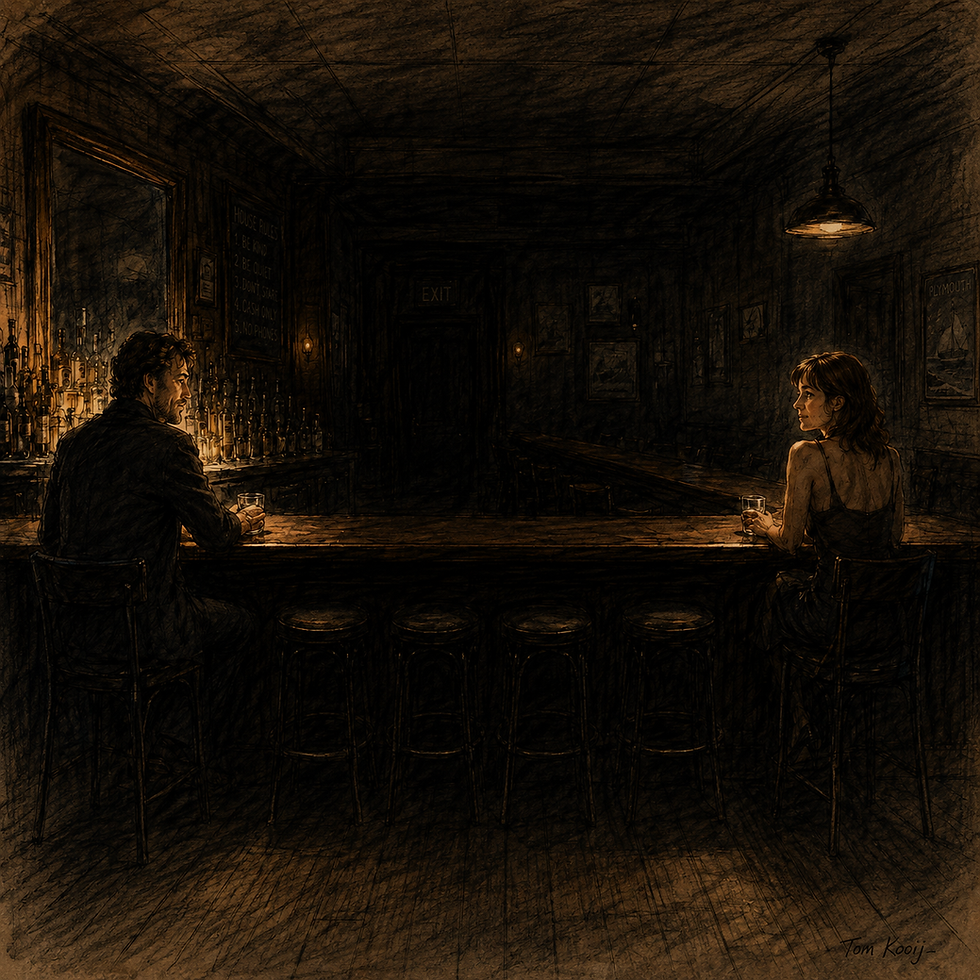
It was a good piece of toast, to be fair. The toast was a sweet-potato rosti, with wagyu tartare and a dark crown of caviar on top. I was there on my own, sitting at the bar, which is where the poor waitstaff have to talk to me for an hour or so, and before a fork went anywhere near it the phone was out. The plate, the carafe, the menu, the room. Once I started eating though, the phone went away... mostly.
Don't get me wrong, we all photograph our food, nobody should feel like a villain for doing it... even Anthony Bourdain did it too. He posted his dinner the night he and Barack Obama folded themselves onto low plastic stools in Hanoi for bún chả and cold beer, I think it cost them six dollars (USD) all up. The difference was the order of operations. He ate first. The photograph was a receipt for something that had already happened to him. That order is what I keep circling.
"Pics or it didn't happen" began as an internet joke. The history of the phrase comes from a moment, around two in the morning on a Tribal War gaming forum in 2003. There was a user who called himself "BlackMyst". He had opened a thread titled “So my sister has her hot friend over” and (with the confidence of a man typing alone in the dark) reported, "there were pillow fights". A minute later another user, Blitzkrieg, replied: “Obligatory ‘pix or it didn’t happen.’” The pics naturally never arrived. The thread of these lonely souls ran on for hours on hope alone, and BlackMyst slipped into internet history as the man who could not produce the proof. Note the word “obligatory”, though. Even when this phrase was first documented, the demand for proof was already a ritual, a rule everyone in the room knew by heart. This is now the working standard of a culture; proof first, presence if there's time.
This is an essay about trust, which sounds like a word for bankers coming to terms with their career choice or marriage counsellors navigating difficult conversations in a wave of unprecedented cases of separation. Underneath it though, is a desire for belonging....
.....and the strange fact that the most visible generations in history report feeling the least held. My research for The Thinning followed meaning through five Australian generations, from the ones who came home from the war to the ones born holding a screen.
The pattern under all of it fits on the back of a napkin; when you trust the room, you live in it, when you don't, you document it.
The Rhine
The detail matters, so here it is (or as much of it as I know). In 1943 the Germans swept my Opa up and sent him to the Roche works at Grenzach, a chemical factory on the German bank of the Rhine, close to Basel. Swiss historians later counted at least 150 foreign forced labourers and 61 prisoners of war put to work there, men from Holland and France among them.
The far bank was Switzerland. Between the two ran the High Rhine, on average more than a thousand cubic metres of water a second, green-black and moving fast past the factory wall. In Basel today they tell summer-swimmers to stay out when the river drops below eighteen degrees. He went in during winter, with another man. I have tried to picture it: the cold that takes the breath before the current takes the legs, fingers turning to hooks, the far bank sliding sideways in the dark, the last pull onto a shore, in a country, which might simply have handed him back. No cold-plunge after your sauna compares...

Somehow he reached France and the Rhône Valley, and there someone hid him in a vineyard cellar until the war was over, with the Germans in the valley above. Anyone who has been down into an old wine cellar knows the quiet of it, the steady cold, the smell of wet stone and oak and wine breathing in the dark. Somebody upstairs must have fed him. Somebody must have kept their mouth shut. They had no proof he was who he said he was, and they trusted him anyway, with their lives.
He died in 1988, on my sister's first birthday. I was three, so the story never came from him. It came from my Oma instead, told often enough that I know it the way you know the shape of a scar on someone else's hand. Nobody in his generation was asked to show their working. You had been through it, the man beside you had been through it, and the going through it was the proof.
The anthropologist Victor Turner had a word for what that kind of passage does to people. He took limen, the Latin for threshold, and described the bond that forms among those caught between one life and the next, stripped of rank, waiting together in the doorway. He called it communitas. I love that word. It sounds like something you could catch, and in a way they did. War is a threshold that lasts six years. The people who came out the other side trusted on sight, and, let's be clear, it was not some blind-innocence, but they had already seen what everyone around them was made of...
Margaret Mead, writing at the end of the 1960s, called this a postfigurative culture, the kind where the future is expected to repeat the past and grandparents set the tone of a life. Your father trusted the butcher's father, so you trusted the butcher. You lent the neighbour the trailer and it came back with the tyres pumped.
Trust was inherited like a surname or some genetic condition, and it was local, its radius the length of a main street and a bank manager who knew your mother's name...
In May 1942, with the war at its darkest for Australians, Robert Menzies went on the radio and gave his famous speech called 'the forgotten people', it was the one where he spoke about, 'material homes', 'human homes' and 'spiritual homes', the core pillars that shaped public policy in Australia over much of the time he held government (go look it up). One line from that broadcast has aged into prophecy: "A great house, full of loneliness, is not a home." He said it eighty-four years ago. It reads like a forecast for the outer-estates of Perth.
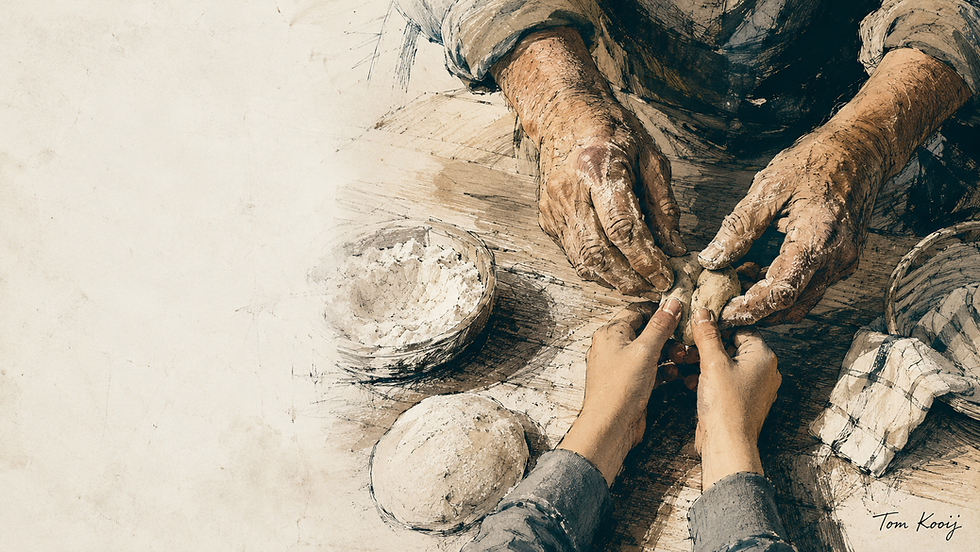
None of this needs romanticising. That generation paid for its trust in silence. Plenty of what they carried went to their death, unspoken, and if you were lucky, some of it came out at the dinner table after a few bottles of cheap red. My Oma, Maria Elisabeth, was that exception. Friesland Dutch, ninety-eight years, a brick house in Berrima with plenty of Shiraz kept in terracotta drainage pipes under the stairs. Somewhere between the cheese board and the groentesoep (a Dutch soup) she would tell you casually that your grandfather had swum the Rhine in the middle of winter. No photographs, no lecture. Just Leidse kaas (a Dutch cheese) on the board and the story set down beside it, which is the only archive some families ever keep.
Pierre Bourdieu called that habitus (I wrote about that here) the stuff absorbed below the level of instruction. Caught, not taught. Nobody explained trust to the children of that war-time generation. They watched it done across counters and back fences, and it went in through the skin.
Receipts
Then the trust moved house. The boomers took their parents' faith and handed most of it to institutions, which seemed reasonable at the time. The bank had marble floors. Thirty-forty years of tenure at a company had a gold watch waiting for you at the end. The church, the union, the ABC news at seven, the doctor who had delivered you: these became the new main street, bigger and further away, and for a while they held. Rachel Botsman, who has spent her career on this question, describes it as (and I am paraphrasing); trust migrating from the local to the institutional, from the person you could see to the system you were told to rely on.
Mead saw the next turn coming, and I think she was being polite about it. Her cofigurative culture is the one where people stop learning mainly from their elders and start learning from each other, and the grandparents' pattern loosens its grip.
Gen X grew up inside that loosening. Two incomes, kids would take themselves home afterschool to an empty house, left to fend for themselves, a generation born on Seinfeld, the Simpsons, grunge...an ironic-detachment. They learned early that adults could be wrong and institutions could lie, and they adjusted their expectations downward with a shrug and sigh and a mumble under their breath of something like, "whatever, didn't expect much anyway"...
This truth was measured too. When the Australian Election Study first asked in 1969 whether the people in government could be trusted to do the right thing, about half said yes. By 2019 it was a quarter, the lowest ever recorded. In between came the royal commissions, into the banks, into what was done to children inside institutions that had been trusted with them, each one a public audit of a promise broken in private. Robert Putnam had already mapped the American version in Bowling Alone, the leagues and lodges emptying out, social capital draining from the civic plumbing one quiet resignation at a time. Swap his bowling alley for the local bowls club and he could have been writing about North Perth.
Now, here is what happens in a room when trust leaves it. Bureacracy moves in. Paperwork grows. Contracts get longer. The handshake becomes a heads of agreement, and the heads of agreement becomes forty pages drafted by people billing in six-minute units. You've signed one of those, haven't you? Francis Fukuyama argued in the nineties that low-trust societies pay a kind of tax on everything they do, the cost of checking what they once took on faith. Every business owner in Perth pays that tax, most have capitulated and just whinge about it now...
The generations that followed did not rebuild the institutions. They built smaller rooms. The curated circle and the founders' table are their answer to the bank and the union they watched their parents lose faith in: smaller, chosen, and accountable to the people in it.
That was the boomers’ quiet invention, and Gen X inherited the filing. If you could not trust, you could at least keep records. The catch is that something which is done for the record slowly stops being done for its own sake and trust goes the same way.
The Score
Mead's third category was the one she thought was arriving as she wrote: 'a prefigurative culture', where change moves so fast the elders end up learning from the young. She meant it hopefully, and I'd like to think she was half right. What she could not have pictured was a generation with nobody ahead of them to copy, handed a device at twelve and told to work out who they were in public.
The psychiatrist Iain McGilchrist has spent his career on the divided brain, and he gives a great explanation of what that public life does to a person. In The Master and His Emissary he argues that the two hemispheres attend to the world in different ways:
The right [hemisphere of the brain] takes it whole and living, in context, in faces, nuance, ambiguity and tone, interconnectedness, implicit meaning and everything left unsaid. It is the part of us that belongs to things. The left breaks the world into pieces it can name and count, and it prefers categorisation, mechanics and total control. The social-feeds are that hemisphere's home ground. It turns a friendship into a follower count and a night into a photograph of a night in a restaurant or night-club bathroom toilet with a friend and gives you a dopamine kick as a bonus...
I find that confronting, mostly as I know which half of me is often holding a phone with the camera out...
Erving Goffman wrote about the front stage and the back stage of ordinary life, the self we present to the room and the self we let slip in the kitchen. The phone abolished the kitchen. There is no back stage when the camera lives in your pocket and the audience never goes home.
Lay his argument over the five generations in my own research for The Thinning and it reads like a slow handover of the house. The wartime generation knew each other the right hemisphere's way, by face and by fire. Their children moved trust into institutions that ran on the left's rules and records. Gen X learned to read the fine print before the person.
Millennials were handed the profile, and Gen Z and Gen Alpha the score, a childhood measured from the first post. Each step made sense at the time. Together they have produced a generation fluent in the left-hemisphere language and only half-taught in the right one, which happens to be the language belonging is spoken in...
Why did the house change hands? I have been fortunate enough to have had dialogue with Jay Hughes Jnr. and Keith Whitaker of Wise Counsel Research, alongside some insights from people from Harvard's Human Flourishing Program, and we keep arriving at the same suspicion. Somewhere in the 1970s, long before anyone called it STEM, schools and universities began tilting hard toward science, engineering and the measurable, and the humanities quietly lost ground. My own view is that this sits near the root of the despondency. History, literature, music and philosophy are where the right hemisphere gets its schooling, where we learn to sit with ambiguity and nuance and read another person's inner life. Thin those out and you raise people who can solve the problem in front of them but struggle to read the person beside them. For some of us, a kitchen table did that teaching anyway. Most kids, though, now get a standardised-syllabus and a screen.
And that's where the phone finished the job. Jonathan Haidt (the author of The Anxious Generation) dates what he calls the great rewiring of childhood to the early 2010s, the years a play-based childhood gave way to a phone-based one. You do not need his stats to see it. Watch a group of sixteen-year-olds at Cottesloe on a Sunday arvo and count the minutes spent in the water against the minutes spent proving they were there. Then, if you're brave, maybe count your own as well.
Erik Erikson put basic trust as the first task of a human life, the infant learning whether the world will come when it cries. Validation is what rushes in when that question stays open. A "like" is a tiny handshake, and the trouble with tiny handshakes is that they expire within the hour. Then you need another and before long the renewing is the life. Which brings the strangest inversion of all. Rachel Botsman calls it distributed trust, and in McGilchrist's terms it is the left-hemisphere's idea of trust.
A twenty-year-old will climb into a stranger's Corolla at two in the morning on the strength of a 4.9 rating, and will not knock on the neighbour's door to borrow an egg. We have learnt to trust a crowd of reviewers we will never meet and lost the knack of trusting the person over the fence.
And like much of the research, none of this is a hunch anymore... The ANU's (Australian National University) June 2026 poll found interpersonal trust in Australia at its lowest point this decade. Ending Loneliness Together reported last year that nearly half of Australians aged fifteen to twenty-five regularly feel lonely.
And the statistic every pop-social-psychology event will wave around is that the US Surgeon General put the mortality risk of disconnection alongside smoking up to fifteen cigarettes a day. A camera roll can hold ten thousand faces and not one who would come at two in the morning...
The Ask
Every generation of teenagers has wanted to be wanted. None of this is new, and anyone who tells you the young are uniquely shallow has forgotten the school social, the note passed in maths, the long walk past a girl's house on the off chance. I certainly haven't. Belonging at fifteen has always been bought with risk. What has changed is the exchange rate.
Hyper-communication bred hyper-engagement, and hyper-engagement has a price, which is hyper-validation, measured in public and refreshed by the minute.
In 2016, a UCLA team led by Lauren Sherman put thirty-two teenagers in a brain scanner and showed them a mock Instagram feed. When their own photos carried plenty of likes, the nucleus accumbens lit up, the same reward circuitry that answers to chocolate and winning money. The harder finding came next: when they looked at risky photos, activity in the brain's cognitive-control network dropped. Sherman put it plainly. A teenager used to have to guess how the room felt about them. A like removes the guesswork. It is a number, and the number never sleeps.
Follow that wiring far enough and you arrive where every parent dreads. The nude, or the request for one, has become a currency of adolescent belonging, traded in bedrooms after lights out on platforms built to make the exchange frictionless.
Researchers at Edith Cowan University, here in WA, interviewed young Australians aged eleven to seventeen and found that for many, their first brush with sexting was an image they never asked for. What they wanted most, looking back, was to have been told before it happened.
Then the predators found the market. Sextortion is old-fashioned blackmail with a phone in its hand: a stranger posing as someone the kid's age, a little flattery, an image, and then the threat. Reports to eSafety went from 432 in 2018–19 to 6,187 four years later. A 2025 study by eSafety and the Australian Institute of Criminology found more than one in ten sixteen-to-eighteen-year-olds had been targeted, over half of them first before they turned sixteen. Julie Inman Grant (the e-safety commissioner) calls it catastrophic, with boys and young men picked off daily by organised criminal networks. Police know of Australian teenagers who have taken their lives in its wake. As a parent, that is the sentence I can't get past.
A like expires within the hour. An image does not. That asymmetry is the whole trap: a feeling that lasts ten minutes at one in the morning, traded for a file that will outlast the friendship and the feeling itself. Whoever is on the other end is warm and quick and seems to see them.
The people running these schemes trade far less on lust than on the hunger to be chosen, and a generation raised on the receipt has been trained to hand over proof on request.
Every generation leaves its children something to unlearn. Ours handed children a device that measures their worth by the hour, then left the room. If there is a defence, it is not a better filter. It is a kid who knows, long before anything goes wrong, that they can walk into the kitchen with the worst thing on their phone and still have the kettle put on.
The Gift
Marcel Mauss, the French anthropologist, spent the 1920s studying how archaic societies held themselves together, and he kept finding the same machinery. A gift, he found, obliges the receiver to accept it and, in time, to return it. The return is never exact and never immediate, and that is the point. The debt keeps people coming back to each other. A transaction ends a relationship cleanly, whereas, a gift starts one and refuses to let it finish. Mauss would have made a cracking maître d'.
Relationships are not exempt from this. Watch how couples find/date each other now and the same rule applies: pics or it didn't happen. First the soft launch, a hand on a steering wheel posted to an IG story, then the hard launch, the face, the caption, the tag. Then the read receipts and the shared locations, and the anxious maths of how long a reply took. You've done the maths, haven't you?
Men and women are both doing it, and underneath it sits the same fear, that if the relationship cannot be seen it might not be real, and if it is not proven early it might not last.
So proof gets demanded before trust has had time to grow. Be posted, be introduced to the family, or the whole thing goes on pause until the next hurdle is cleared. But a boundary says "what I need", and an ultimatum says "what you must do"; one grows trust slowly, the other harvests compliance and calls it commitment. Love has always needed the early weather of ordinary days, two people learning each other without an audience.
Families run on Mauss's machinery, or they used to. The Productivity Commission estimated in 2021 that around $3.5 trillion will pass between Australian generations by 2050. Almost none of the families I sit with worry about whether the money will arrive. They worry about whether anything else will arrive with it. And here is the hard fact:
trust cannot be bequeathed. It has to be practised, at the table, in small repeated gifts of attention, until the next generation has done it enough times to own it. Bitterness kills an inheritance faster than any tax.
Business is no different, it just has better stationery. Amy Edmondson's work on psychological safety, and Google's Project Aristotle after it, found that the teams that perform are the ones where people believe they will not be punished for speaking up. That is trust with a lanyard on. No values statement can mandate it. It is built or lost in rooms, mostly in the first few seconds of someone walking into one.
You can feel the hunger for those rooms right across the country now. Private business circles with curated tables and earned access, founders who lift at five and close deals by nine, dinners where the guest list is the product. The best of them have worked out something the platforms missed: output follows trust, and trust needs a room with standards, not another channel to scroll. There is a tension worth naming, though. A gate at the door is fine. A gate inside the room, where you have to keep proving you belong once you are in, is just your social-media feed with catering. Business schools call a crowded market a red ocean, every competitor bleeding into the same water for the same customers, and an uncontested one a blue ocean, open water where nobody else is fishing. Validation is the reddest ocean there is. Trust is blue water: it cannot be bought or posted, so almost nobody competes for it.
Peter Senge would recognise the pattern. In The Fifth Discipline he describes a system trap he calls shifting the burden: a quick fix eases the symptom, the real problem goes untreated, and over time the fix wears away the system's capacity to solve it properly. Validation is that fix. Each 'like' soothes the ache of not belonging and leaves a person a little less practised at the slow work that would end it. McGilchrist would say the trap is older than the phone.
A system built by the left hemisphere will always reach for what it can measure, and belonging is the one thing that will not hold still long enough to be measured. Better filters and kinder algorithms are just the left hemisphere trying to fix its own work.
The real lever is the question a room puts to whoever walks in, and there are only two versions of it. What can you prove? Or, who are you?
That threshold is where I have developed a body of work and it is found in the eleven seconds in which a person decides, before a word is said, whether they belong here. Turner's limen again, the doorway where you find out whether you'll be asked for proof or simply let in.
The rooms that let people in well usually learned how out the back first. Think how every serious kitchen still keeps the family meal, the staff sitting down together before service to eat whatever the most junior cook could make from the trim. Bourdain came up through kitchens like that. Nobody photographs the family meal. It is not content. It is the gift that lets a brigade of near strangers trust each other with knives at nine o'clock on a Saturday night.
The Floor
Back at the bar, the thing most worth recording that night was the one thing I couldn't: the floor crew working a full room, doing what good floor staff do without being seen to, the glance that clears a plate, the pause before a glass runs dry, the read of a solo diner who wants talking to against one who wants to be left with his thoughts. That is trust practised in real time by people paid to notice.
At the end of the day, the phone is not the villain; it is only very good at being pointed at the wrong thing. Simone Weil, writing in 1942, the same year Menzies was on the radio, called "attention the rarest and purest form of generosity." I love that line. McGilchrist goes further. “The kind of attention we pay actually alters the world,” he writes, and in his telling the left hemisphere, built to serve as the emissary to the right, has ended up running the house. Point the left at a dinner and you get a photograph. Point the right at a room and you get the people in it. A like is the left hemisphere's native tongue. The floor at Balthazar speaks the right's, and it cannot be screenshotted. It can only be felt, by whoever came in alone and, for a couple of hours, wasn't.
No pics. It happened.
-TK
Comments